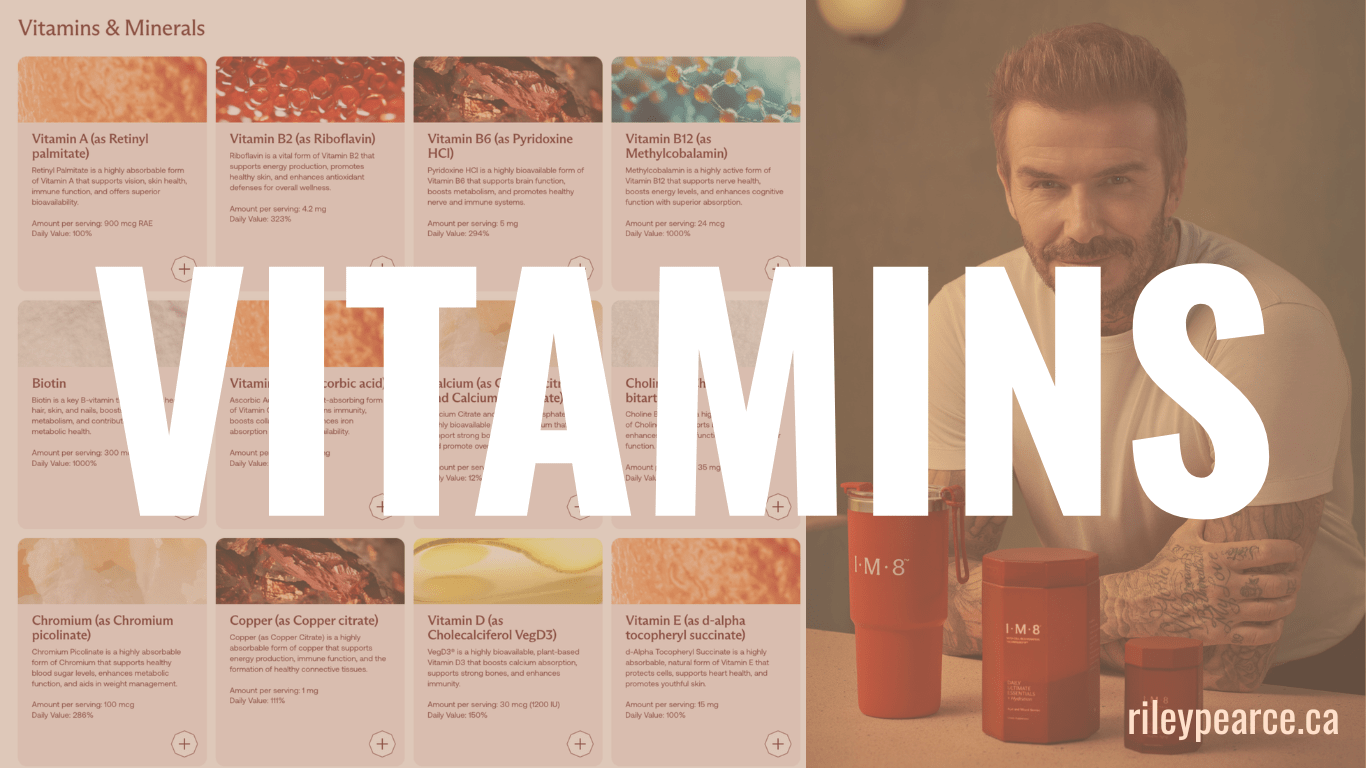
IM8 Ingredients Deep Dive – Part 1: Vitamins

IM8 is the new all-in-one supplement on the block, and along with some serious scientific research to back them, they also have an impressive list of ingredients.

But are all of these ingredients really necessary? Did they use the best form of each to maximize potency and absorption for the average person? In this new series, I am going to go through the IM8 ingredients list – all 92 ingredients – to better understand why they included it in their products, if they chose a good source for that particular benefit, and what I recommend you do to make the most of these ingredients.

The Ingredients List

When you go to the ingredients section of their site, they’ve very conveniently broken it down by product (the ultimate supplement and the longevity supplement) and by benefit group.

For this first installment, I am going to cover all of the vitamins in their ingredient list, explain to you why they are important for your health, how much you need, and where you can get these vitamins in your diet.

As I’ve said many times on my blog before, supplements are meant to supplement your diet. So although there are some ingredients on their list with more than enough to satisfy your daily requirements, you’ll see some ingredients on their list with less than the daily requirements. This is normal, and should act as a reminder that you should be getting the rest of your daily intake from whole food sources.

Alright, let’s get into the vitamins in IM8’s Daily Ultimate Essentials.

What are vitamins?

To give you a quick understanding of why they highlight this as a group of ingredients, vitamins and minerals are micronutrients.

Micronutrients are essential nutrients you need in smaller quantities to support your daily bodily functions.

They are all essential because when you don’t get enough of them in your diet, the consequences can go so far as being fatal.

So, let’s get into the different vitamins and minerals listed in their ingredients list.

VitaminsMinerals
Vitamin A (as Retinyl palmitate)Calcium (as Calcium citrate and Calcium phosphate)
Vitamin B2 (as Riboflavin)Choline (as Choline bitartrate)
Vitamin B6 (as Pyridoxine HCl)Chromium (as Chromium picolinate)
Vitamin B12 (as Methylcobalamin)Copper (as Copper citrate)
BiotinIodine (as Potassium iodide)
Vitamin C (as Ascorbic acid)Magnesium (as Magnesium glycinate)
Vitamin D (as Cholecalciferol VegD3)Manganese (as Manganese citrate)
Vitamin E (as d-alpha tocopheryl succinate)Molybdenum (as Molybdenum amino acid chelate)
Folate (as Quatrefolic (6S)-5-Methyltetrahydrofolic acid glucosamine salt)Phosphorus (as Calcium phosphate)
Vitamin K (as Phylloquinone)Potassium (as Potassium citrate)
Vitamin K2 (as Menaquinone-7)Selenium (as Selenomethionine)
Niacin (as Niacinamide)Zinc (as Zinc citrate)
Pantothenic Acid (as Calcium pantothenate)
Thiamin (as Thiamin HCl)

Vitamin A (as Retinyl palmitate)

Amount per serving: 900 mcg RAE (retinol activity equivalents)
Daily Value: 100%

Vitamin A is one of four fat-soluble vitamins, meaning they have to be consumed with a source of fat for our bodies to absorb them.

This form of vitamin A is a naturally occurring form most commonly found in eggs, cheese, and liver.

I have to be honest – I am a huge advocate for adding organ meats to your diet because they are so rich in vitamins and minerals, and typically offer the highest quantities per gram and the most absorbable version.

So when I researched retinyl palmitate and it said it was the version of vitamin A found in liver, I felt really good about this choice.

So, right out of the gate, IM8 is starting strong with its ingredient choices. Now, I will say that they don’t say where they sourced their retinyl palmitate from, but a lot of their claims are about sourcing ingredients from the highest quality sources, so we’ll have to trust them on that.

Why is vitamin A important?

As I mentioned before, all vitamins and minerals are essential nutrients because not only do they support normal bodily functions, but on the other side of the coin, they could have devastating effects if don’t get enough of them.

Vitamin A is responsible for maintaining a healthy skin barrier, good vision, healthy metabolism, and a strong immune system.The recommended intake of vitamin A for women is 700 micrograms/day and 900 micrograms/day. We can see from the IM8 website that their supplement has more than enough for women, and 100% of the recommended daily dose for men.

Not only do we want to make sure we consume enough vitamin A to support the aforementioned systems, but we also want to protect ourselves from the consequences of vitamin A deficiency.

When we do not get enough vitamin A (less than 20 micrograms/day), the first symptom will be night blindness. If the deficiency persists, your eyes will get dry, you won’t be able to produce tears, and eventually your eyes can get to a really bad place with open sores.

By taking IM8, you can feel confident that you are getting enough vitamin A to support healthy vision, immune function, skin health, and metabolism.

Vitamin B2 (Riboflavin)

Amount per serving: 4.2 mg
Daily Value: 323%

Vitamin B2 is part of a larger family of B vitamins that are critical for energy and brain health, along with supporting other systems in the body. The B vitamins are water-soluble vitamins, so the body will use what it needs and then rest is flushed out in our urine.

It is common practice for multivitamin supplements to have more than the recommended dose of water-soluble vitamins because any excess will be excreted from the body. Having more than enough ensures maximum absorption by the body.

Why is Vitamin B2 important?

Vitamin B2, as well as all other B vitamins, helps the body break down carbs, fats, and proteins and turn them into energy that the body can use. Riboflavin also helps the body break down B6 and folate, 2 vitamins that are especially critical for women during pregnancy.

Riboflavin is also an antioxidant. This is a common term in the health and wellness industry, so let me quickly explain why anti-oxidants are great to include in your diet.

There are damaging particles in your body called free radicals. Free radicals are associated with the aging process and breaking down cells. Anti-oxidants circulate the body fighting off these free radicals, meaning your cells are protected and you will age more slowly. I’ve included a helpful image below to with a list of plant-based sources of anti-oxidants.

How much do we need to maintain a healthy body?

It is important to note that men and women require different amounts of vitamin B2 to support their unique body functions. Pregnant women, breastfeeding women, and people over the age of 50 will also have different doses due to the way to body absorbs vitamins as we age, and the additional nutrients needed to support a healthy baby.

For men and women between the ages of 19 and 50 years old, you need 1.3mg/day. You’ll notice this is far below what IM8 has included in the Daily Ultimate Essentials supplement. Again, vitamin B2 is a water-soluble vitamin so any riboflavin that isn’t used by the body will be excreted.

For women over the age of 50, you need 1.5mg/day. Men over the age of 50 need a little more, at 1.7mg/day. Pregnant women require 1.9mg/day, and breastfeeding need the most vitamin B2, at 2mg/day.

Where can you find this in natural food sources?

Riboflavin is present in various food sources, including:

  • Poultry (chicken, turkey)
  • Fish (salmon, tuna)
  • Bananas
  • Potatoes and other starchy vegetables
  • Fortified cereals
  • Nuts and seeds

The B vitamins are a very important set of vitamins so I happy to see the IM8 has chosen to include more than enough vitamin B2 in in their daily supplement. I have had a B complex supplement sitting in my cupboard for months and know that I am missing out a powerful dose of vitamins, so IM8 will be the supplement to make sure I am actually taking my B vitamins.


Vitamin B6 (as Pyridoxine HCl)
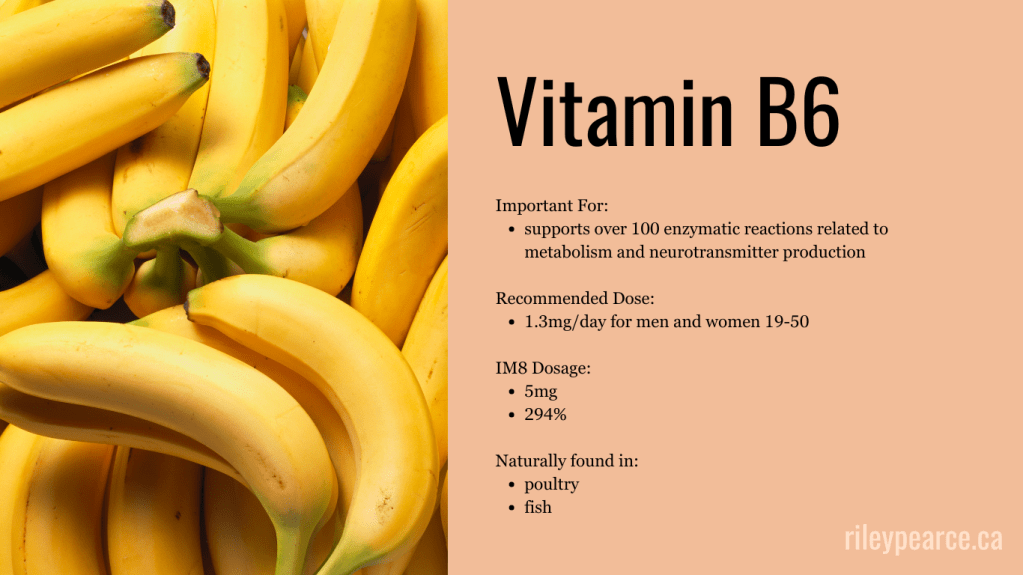
Amount per serving: 5 mg
Daily Value: 294%

What is it?

Vitamin B6 is a water-soluble vitamin involved in over 100 enzymatic reactions, primarily related to protein metabolism and neurotransmitter production. An enzyme, to take you bake to high school biology, is a catalyst, meaning that it helps speed up the rate of a reaction in the body.

This B vitamin is absolutely crucial for normal brain function and to keep your nervous system healthy and functioning as expected. Your nervous system quite literally controls everything. So making sure you are consuming enough B6 is so important, and is likely why IM8 has included more than enough for one day.

Why is it important to human health?

When the body has a enough B6, it will support a number of critical bodily functions. Not to pick favourites, but the fact that vitamin B6 is an important factor in the development of our brains, and helps keep our brains working properly should be enough to really drive home the important of this vitamin.

Another cool function of B6 is that it helps produce the neurotransmitters (the biological messengers of the nervous system), specifically serotonin and dopamine, two neurotransmitters that I am sure we are all familiar with. They help us feel that sense of euphoria when we go for a long run, and dopamine is important for our biological reward system, which can help with motivation and habit formation.

Beyond our beautiful brains, vitamin B6 is hard at work helping to produce red blood cells, and essential components of our immune system. It also helps maintain a healthy heart by reducing homocysteine . When the body has too much homocysteine, this can lead to blood clot formation, and increases your risk for heart disease and stroke.

How much do we need to maintain a healthy body?

As I mentioned, IM8 made sure that you have more than enough vitamin B6 when you take their daily supplement. But just so you’re prepared for your next micronutrient trivia night, here are the recommended daily intakes for vitamin B6:

  • Women (19–50 years): 1.3 mg/day
  • Women (51+ years): 1.5 mg/day
  • Men (19–50 years): 1.3 mg/day
  • Men (51+ years): 1.7 mg/day
  • Pregnant women: 1.9 mg/day
  • Breastfeeding women: 2.0 mg/day

Where can you find this in natural food sources?

Similarly to vitamin B2, you can find vitamin B6 in many staple food items such as poultry (chicken, turkey), fish (salmon and tuna), bananas, starchy vegetables like potatoes, and nuts and seeds.

After going through the research on this, I am really kicking myself for not taking that B complex supplement that’s been sitting in my cupboard these last few months.

Vitamin B12 (as Methylcobalamin)
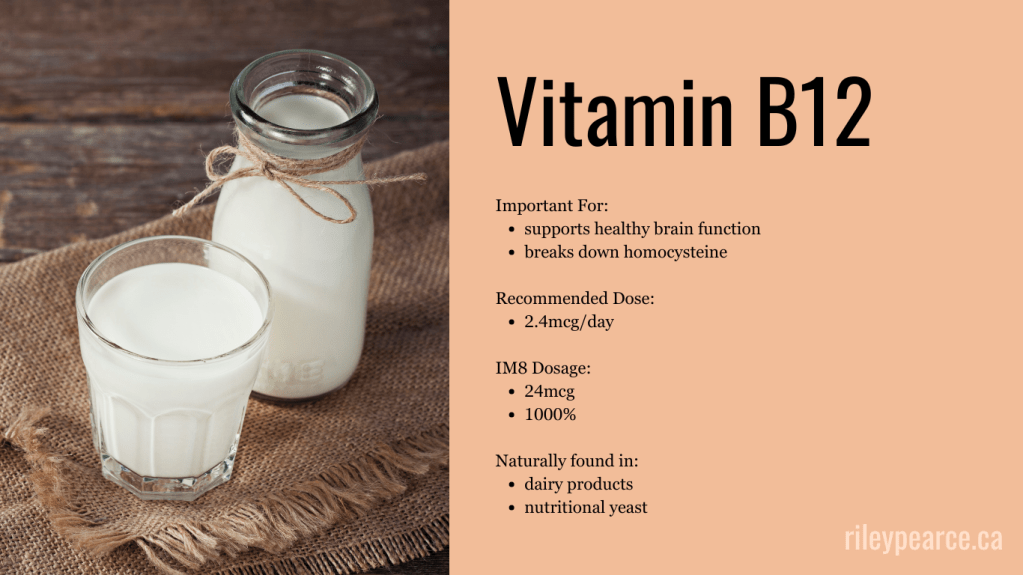
Amount per serving: 24 mcg
Daily Value: 1000% (!!)

What is it?

Vitamin B12 is another water-soluble vitamin that will help keep your nervous system running smoothly, will develop healthy blood cells and even plays a part in the creation of new new DNA. IM8 has done it again, and by using methylcobalamin, they’ve chosen the bioactive form of vitamin B12, which makes it highly absorbable, and should leave you feel confident that your body has all the B12 it needs.

Why is it important to human health?

Remember that funny term from the previous section, homocysteine? Here’s a refresher if you’ve forgotten or you’ve been reading this article in more of a “choose your own adventure” format.

Homocysteine is something that can naturally build up in the cardiovascular system (your heart and blood vessels). When the body has too much of it, blood clots can form, leading to a higher risk for heart disease and stroke.

Vitamin B12 is one of the key catalysts that help break down homocysteine so that we do not have a build up, and we can rest easy knowing our heart and blood vessels have the best biological clean-up crew taking care of things.

When vitamin B12 isn’t keeping our heart healthy, it is also support our nervous system (classic B vitamin), it is preventing anemia by supporting the healthy formation of red blood cells, it promotes healthy cell division and, last but not least, plays an important role in providing us with enough energy that we feel less fatigued throughout the day.

How much do we need to maintain a healthy body?

When you see how much we need of B12 in a day, and how much IM8 has packed into the daily supplement, you realize that maybe this isn’t just another brand cashing in on the supplement industry. They are certainly turning this skeptic into a bit of a believer!

Here are the recommended dose of vitamin B12:

  • Adults (19+ years): 2.4 mcg/day
  • Pregnant women: 2.6 mcg/day
  • Breastfeeding women: 2.8 mcg/day

Where can you find this in natural food sources?

As always, I want to make sure you know that you can also get vitamin B12 from natural food sources. As with other B vitamins, you can find vitamin B12 in poultry, fish and beef, but it can also be found in these sources as well:

  • Dairy products (milk, cheese, yogurt)
  • Eggs
  • Fortified plant-based foods (cereals, plant milks)
  • Nutritional yeast

What happens when you don’t get enough?

If the above sections haven’t already made you realize how important vitamin B12 is, I also wanted to include what happens when we are deficient in B12. Specifically because vitamin B12 in it’s most bioavailable form and in its highest quantities is found in animal products. So for those of you who are following a plant-based diet, I believe it is important for you to understand why you have to supplement with vitamin B12 so you can avoid the following symptoms of deficiency:

  • Fatigue, weakness, and dizziness
  • Nerve damage leading to tingling or numbness in hands and feet
  • Memory loss and difficulty concentrating (brain fog)
  • Megaloblastic anemia (enlarged, poorly functioning red blood cells)
  • Increased risk of depression and mood changes*

We are not done yet with all of the B vitamins, but I hope you’ve noticed the pattern that these vitamins are really important for your brain health, but also play an important role in your mental health. From helping with serotonin and dopamine production, to improving your energy levels, and maintaining a balanced mood, this family of vitamins really is incredible and it makes sense why IM8 has absolutely packed their daily supplement with more than enough B vitamins.


Biotin

Amount per serving: 300 mcg
Daily Value: 1000%

What is it?

Biotin, another B vitamin (B7), plays a key role in energy metabolism and the health of hair, skin, and nails. It has become popularized by many of the hair, skin and nails supplements that you can find at your local pharmacy, but also has an important role to play in your metabolism (the breakdown and absorption of nutrients) and is really important for the healthy development of the baby during pregnancy.

Why is it important to human health?

With this next B vitamin, we see it working alongside the other B vitamins to keep our brain and nervous system working well. But biotin’s greatest claim to fame is it’s role in keeping our hair, skin and nails healthy.

Biotin supports healthy hair, skin and nails because it is a coenzyme that helps break down amino acids that are required for the maintenance of hair, skin and nails. Specifically is helps with the production of collagen, which I’ve written about in this article if you’re curious about how collagen works.

Vitamin B7 is especially important to pregnant folks because biotin helps with the healthy development of the embryo, or the initial bundle of cells that eventually develop into a fetus.

How much do we need to maintain a healthy body?

As with the other B vitamins, IM8 has included more than enough biotin to maintain healthy levels, but for your reference, here are the recommended daily intakes of vitamin B7:

  • Adults (19+ years): 30 mcg/day
  • Pregnant women: 30 mcg/day
  • Breastfeeding women: 35 mcg/day

Where can you find this in natural food sources?

I love the B vitamins for many reason (if you can’t tell already), but one of the big reasons is that it justifies my daily intake of eggs, but also my ongoing battle with the quality of egg yolks in Canada and the US. The richer the colour of the egg yolk, the more nutrients are available. An egg yolk that probably has a lot of biotin will be a deep orange colour, which is almost unheard of here in north America, so another reason to supplement with IM8 to make sure you’re getting enough.

Okay enough about egg yolks!

You can also get biotin from the following whole food sources:

  • Nuts and seeds (almonds, walnuts)
  • Whole grains
  • Meat and fish
  • Sweet potatoes
  • Avocados

Vitamin C (as Ascorbic Acid)

Amount per serving: 900 mg
Daily Value: 1000%

What is it?

Vitamin C is a one of the better-known vitamins. I grew up with a Costco sized container of vitamin C and always looked forward to that little orange-flavoured tablets in the morning.

We were always told that vitamin C was important for a strong immune system, with products like Ener-C promoting the cold-fighting benefits of high doses of vitamin C. There is some research to support this as well, so it is great to see that (yet again) IM8 has absolutely loaded the daily supplement with more than enough vitamin C.

Why is it important to human health?

Not only does vitamin C support a healthy immune system, but it is a bit of a multi-tasker.

When it isn’t helping the body fight off infections, it is also helping the body create collagen. Collagen is the most abundant form of protein in the body and support healthy joins, hair, skin, nails and even creates the protective layer around vital organs.

Not only is vitamin C helping to produce our most abundant protein, but it is also protecting our cells from damage (remember antioxidants from vitamin B2?). And for my plant-based pals, vitamin C is crucial for helping you absorb the iron that is found in fruits, vegetables and legumes. Vegans know that consuming enough iron is really important to ensure you don’t become anemic, so it is really important to also consider your vitamin C intake as a vegan girlie.

How much do we need to maintain a healthy body?

With so many important jobs in the body, it makes sense that we need a good amount of vitamin C in order to maintain healthy body functions. These are your recommended dose of vitamin C, but as always, you are getting more than enough from IM8.

  • Women (19+ years): 75 mg/day
  • Men (19+ years): 90 mg/day
  • Pregnant women: 85 mg/day
  • Breastfeeding women: 120 mg/day

Where can you find this in natural food sources?

Vitamin C can be found in lots of delicious fruits, making it one of the easier vitamins to get adequate amounts from our diet. However in northern climates, like my home of Montreal, Canada, these yummy fruits aren’t always in season, so supplementing vitamin C can be helpful to keep us healthy during the winter months.

Here are the common whole food sources of vitamin C:

  • Citrus fruits (oranges, lemons, grapefruit)
  • Strawberries
  • Bell peppers
  • Broccoli
  • Tomatoes
  • Kiwi

What happens when you don’t get enough?

I’ll never forget high school history class and learning that scurvy, the rotting teeth disease that sailors suffered during the colonization the Americas, was caused by a vitamin C deficiency.

Thankfully we are able to get vitamin C from our diets today, so many of us do not have to live in fear of developing scurvy. Again, if you are eating a balanced diet or taking a vitamin C supplement, you won’t need to worry about these symptoms, but just wanted to share the signs of vitamin C deficiency so you can understand the other side of the spectrum:

  • Weakened immune system and increased susceptibility to infections
  • Slow wound healing and easy bruising
  • Dry, rough skin and increased risk of wrinkles
  • Bleeding gums and loose teeth (severe deficiency leads to scurvy)
  • Fatigue and joint pain

Vitamin D (as Cholecalciferol VegD3)
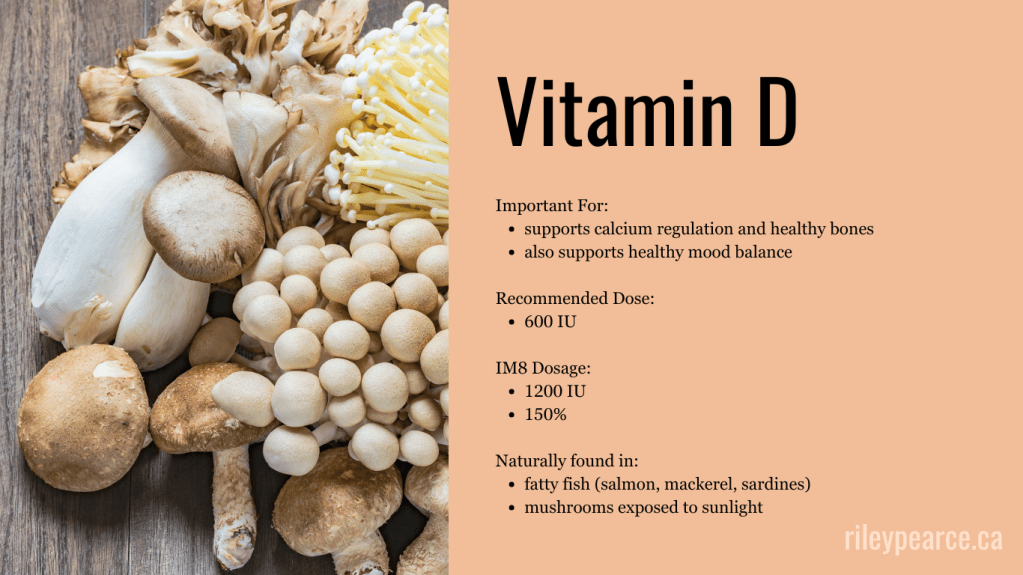
Amount per serving: 30 mcg (1200 IU)
Daily Value: 150%

What is it?

Vitamin D is a fat-soluble vitamin just like vitamin A. This means that vitamin D requires fat in order to be absored by the body.

Vitamin D is a special vitamin, as it is so important to maintaining a healthy body that it is considered a pro-hormone in some scientific circles. It is involved in the regulation of calcium and phosphorus levels, supports bone health and plays an important role in maintaining healthy immune function.

IM8 has chosen vitamin D in the cholecalciferol (Vitamin D3) form as this is the most effective form for raising blood levels of vitamin D.

Why is it important to human health?

I like to think of vitamin D as the sunshine vitamin. As someone from a northern climate, where the amount of sunshine we are exposed to throughout the year varies depending on the season, vitamin D is something that we have to supplement in our diet during the winter months.

We naturally produce vitamin D when our skin is exposed to sunlight, but when you’re bundled up in the winter and the sun is only out between 8:30 AM and 4PM, we just aren’t produced enough of it. On the opposite side of the world, it has been said that Australians can also be deficient in vitamin D because the sun is too hot, so they are not getting out during the day when the sun is at its strongest.

I have found that when I properly supplement with vitamin D, my mood in the winter is much better. Seasonal affect disorder (S.A.D.) is a very real thing that we northerners have to deal with every year in the winter, but studies have shown that supplementing with vitamin D has been shown to help with some of the symptoms of S.A.D.

Beyond mood, vitamin D also supports a healthy immune system, something that also tends to suffer in the winter months. Additionally, vitamin helps with the natural absorption of calcium, strengthening the bones, something we’ll get into in the next part of this series when I cover minerals.

Safe to say that vitamin D is incredibly important, so it is great to see that IM8 has packed their daily supplement with more than enough.

How much do we need to maintain a healthy body?

When it comes to supplementing vitamin D, the amount varies depending on your age and your ability to absorb vitamins. I’d also like to include here that folks with attention deficit and hyperactivity disorder (ADHD) should be especially focused on getting enough vitamin D, as studies have shown that vitamin D deficiency can worsen symptoms.

  • Adults (19–70 years): 600 IU (15 mcg)/day
  • Adults (71+ years): 800 IU (20 mcg)/day
  • Pregnant and breastfeeding women: 600 IU (15 mcg)/day

A quick vitamin D fun fact that I love to share: In the summer months, pale skin can naturally produce up to 10,000 IUs of vitamin D with just 15 minutes of sun exposure. After that, make sure you put on your sunscreen! However, more melinated skin tones produce less vitamin D from natural sun exposure and typically require more time in the sun to produce the same amount of vitamin D.

Where can you find this in natural food sources?

Although the sun is an excellent source of vitamin D, we can also get small amounts of vitamin D from whole food sources like fatty fish (salmon, mackerel, sardines), as well as fortified dairy products and plant-based milk. They’ll typically include something on the packaging to let you know that the product has been fortified with vitamin D.

Some other interesting sources of vitamin D are egg yolks and mushrooms that have been exposed to sunlight. It’s amazing how much is packed into the yolks of eggs. But I also love when mushrooms are listed as a source of a vitamin or mineral. I heard someone say on a cooking show that eating mushrooms is like eating a piece of the earth. If you romanticize your food like me, that will make you appreciate mushrooms a little more.

What happens when you don’t get enough?

Vitamin D deficiency is actually more common than some of the other vitamin deficiencies because our body can make so much of it on its own when exposed to sunlight. So in those times when we aren’t seeing the sun, it is common to experience some of these deficiency symptoms.

  • Weak bones and increased risk of osteoporosis
  • Muscle weakness and joint pain
  • Increased susceptibility to infections
  • In severe cases, rickets in children and osteomalacia in adults

Vitamin E (as d-alpha tocopheryl succinate)

Amount per serving: 15 mg
Daily Value: 100%

What is it?

Vitamin E is the third of four fat-soluble vitamins and a powerful antioxidant that helps protect cells from oxidative damage. As mentioned previously, antioxidants protect your cells from damage. Oxidative damage relates to a specific type of damage certain free radicals that can lead to broader damages to organs and disease.

Once again, IM8 went for the most bioavailable form of vitamin E by using d-alpha tocopheryl. At this point we should come to expect this from IM8.

Why is it important to human health?

I have always known vitamin E as an important vitamin for healing wounds. When I had surgery to remove a cyst from my back, I made sure I had a gel with vitamin E as a main ingredient because I knew it would help the incision heal, and ideally leave me with less of a scar.

Turns out vitamin E isn’t only good for the outside of your body, but it is also keeping things protected internally as well. As I mentioned before, vitamin E is a powerful antioxidant, protecting cells from damage related to oxidative stress.

But what I have also discovered while doing research on vitamin E is that the type being used in IM8 is commonly used to deliver medication more effectively to cells. Specifically, recent studies have shown that not only is it a great carrier for medication, but it may actually interact with certain cancer cells, cause something known as apoptosis, or the death of a cell. And in the case of cancer cells, cell death is exactly what we want.

I found this interesting given IM8 is backed by Prenetics, which is a company that does a lot for cancer research and treatment. Me thinks this was intentional!

How much do we need to maintain a healthy body?

It doesn’t take a whole lot to get your daily dose of vitamin E, so IM8 has given you exactly what you need for one day’s intake. The rest that you absorb from whole food sources is just gravy!

  • Adults (19+ years): 15 mg/day
  • Pregnant women: 15 mg/day
  • Breastfeeding women: 19 mg/day

Where can you find this in natural food sources?

If you are eating a plant-based diet, or a plant-forward diet, chances are you are getting plenty of vitamin E from your food. A quick 30 gram, or a quarter cup, provides you with 7.7mg of vitamin E.

Here are some other whole food sources of vitamin E:

  • Nuts and seeds (almonds, sunflower seeds)
  • Spinach and other leafy greens
  • Avocados
  • Vegetable oils (sunflower, safflower, olive oil)
  • Fortified cereals

What happens when you don’t get enough?

For a vitamin that offers your cells protection both inside and outside the body, it should come as no surprise that when you don’t get enough vitamin E, your body suffers. You are at a higher risk of developing disease and your muscles and joints feel weak and sore.

Good thing IM8 has all you need for one day in just one serving!


Folate (as Quatrefolic (6S)-5-Methyltetrahydrofolic acid glucosamine salt)

Amount per serving: 400 mcg DFE (dietary folate equivalents)
Daily Value: 100%

What is it?

We’re back with another B vitamin! Folate, or vitamin B9, is a water-soluble vitamin essential for making new DNA, new red blood cells, and fetal development. Similarly to the other B vitamins we’ve seen, they have are part of some pretty critical functions, so it is important to get enough from your diets and supplements.

By now I hope this comes as no surprise, but the Quatrefolic form is a highly bioavailable version of folate. So once again, IM8 really went for it went it came to sourcing a high quality folate ingredient.

Why is it important to human health?

Fun fact – your cells are dividing all the time. DNA synthesis and cell division is something that just hums along without us even noticing. Folate is there to help make sure this happens smoothly every time. It’s a big task, but if any vitamin can handle it, it’s a B vitamin.

Similarly to other B vitamins, folate also helps with red blood cell formation and preventing anemia and it also supports the regulation of homocysteine, that pesky molecule that can lead to blood clots and heart disease.

Folate’s true claim to fame is its importance for pregnant women. Folate is crucial in the formation of the neural tube of a fetus. The neural tube is what eventually becomes the baby’s brain and spinal cord. So any issues with the development of the neural tube, will likely lead to issues later in the baby’s development. This is why folate can be found in such a high dosage (600mcg) in prenatal vitamins.

How much do we need to maintain a healthy body?

IM8 has enough folate to support adults of all ages who are not pregnant or breastfeeding.

  • Adults (19+ years): 400 mcg/day
  • Pregnant women: 600 mcg/day
  • Breastfeeding women: 500 mcg/day

Where can you find this in natural food sources?

Once again, my plant-based girlies are likely getting plenty of folate in their diets. If you are not plant based, IM8 has you covered, but it is always good to include the following whole-food sources in your diet as well:

  • Leafy greens (spinach, kale, lettuce)
  • Legumes (lentils, chickpeas, black beans)
  • Citrus fruits (oranges, lemons)
  • Fortified grains and cereals
  • Eggs

What happens when you don’t get enough?

Similarly to other B vitamins, when you don’t get enough folate, you risk developing heart disease due to the build up of homocysteine.

Specific to folate, however, if you do not get enough during pregnancy, you risk birth defects in the baby due to the underdevelopment of the neural tube.

I’ve spoken a lot about pregnancy here, so I will say that as per IM8’s FAQ, they (very responsibly) recommend that you speak with your physician before taking IM8 during pregnancy or while breastfeeding. I imagine if you are reading this and you are currently pregnant or breastfeeding, you have heard this 100 times, but just wanted to be sure to include it here.


Vitamin K (as Phylloquinone)

Amount per serving: 30 mcg
Daily Value: 25%

What is it?

Vitamin K is the fourth and final fat-soluble vitamin. It that plays a crucial role in blood clotting and bone metabolism. Phylloquinone (Vitamin K1) is the primary form found in plant-based foods, is best consumed with a fat source, and is non-toxic in high doses.

Why is it important to human health?

Vitamin K is really important for blood clotting. Blood clotting is a crucial function of the body as it helps seal wounds, preventing outside bacteria and potential infection from entering the blood stream. So it’s really important to make sure your body is getting enough vitamin K so that this process can happen without any delays.

Vitamin K also works with one of our other fat-soluble vitamins, vitamin D, to maintain healthy levels of calcium in our bones, keeping them strong and healthy.

How much do we need to maintain a healthy body?

Now you may be looking at the dosage here and be thinking, that’s weird – they only gave us 25% of your daily recommended intake. This is, of course, by design. Vitamin K is one of those vitamins where if you consume too much – like way too much – you actually risk rupturing red blood cells and jaundice, the yellowing of the skin and eyes. Again, it takes a lot of vitamin K, and the form that they’ve used can actually be safely consumed in high doses without the risk of reaching toxic levels.

But just wanted to clear that up in case you were wondering why they only put 25% of your daily recommended intake in the daily supplement.

  • Women (19+ years): 90 mcg/day
  • Men (19+ years): 120 mcg/day

Where can you find this in natural food sources?

You know how we’ve been told to always consume our dark leafy greens. Well if their appearance in so many of the lists before this one wasn’t enough, then hopefully this list convinces you. Vitamin K1 is most commonly found in dark leafy greens, cruciferous vegetables like broccoli, and green peas. If you want vitamin K, you gotta eat your greens!

What happens when you don’t get enough?

Not getting enough vitamin K1? Then you can expect your body to struggle to form blood clots, and you may experience weaknesses in your bones due to poor regulation of calcium in those very bones.

So take your IM8 daily supplement, and eat your leafy greens!


Vitamin K2 (as Menaquinone-7)
Amount per serving: 40 mcg

What is it?

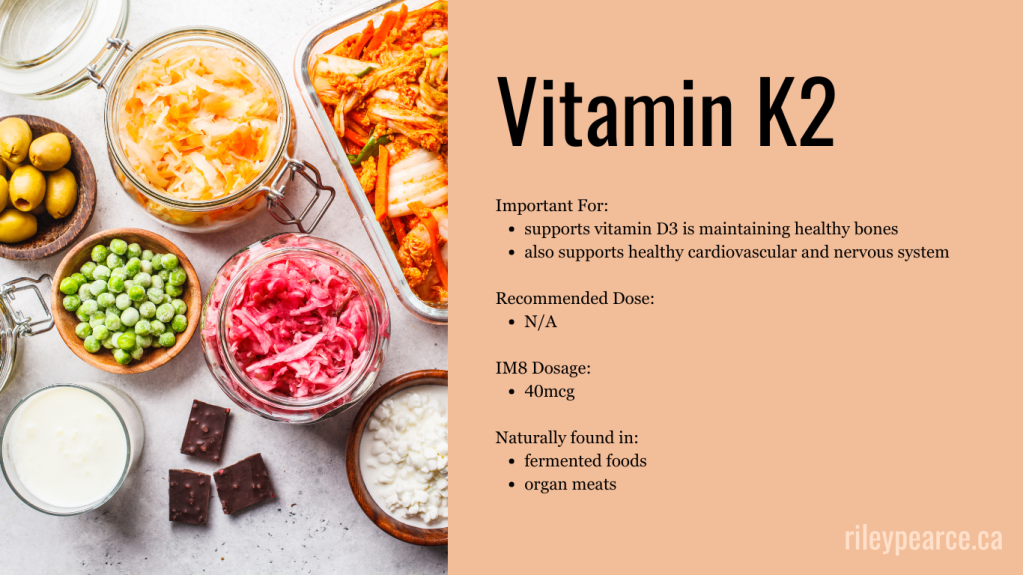
Vitamin K2 is another form of Vitamin K, mainly involved in directing calcium to bones and teeth while preventing it from accumulating in arteries. Menaquinone-7 (MK-7) is a highly bioavailable form that is synthesized by certain bacteria, especially those found in fermented foods.

Why is it important to human health?

Vitamin K2 is the second form of vitamin K, and is found in much smaller quantities in whole food sources. It’s primary role is to work with vitamin D3 to support healthy bones by regulating calcium metabolism. This, of course, helps prevent osteoporosis, as we saw with vitamin D.

Some studies have also shown the vitamin K2 to be good for the healthy maintenance of our cardiovascular system and our nervous system, but more research still needs to be conducted.

How much do we need to maintain a healthy body?

There isn’t one agreed upon amount for vitamin K2 specifically, which is probably why IM8 left out the daily value for this particular vitamin. If we combine this vitamin K with the previous, and assume that those recommendations are for your total vitamin K consumption, then you’d be sitting at about 70mcg of vitamin K, which is within a healthy range of the recommended dose.

Please note that vitamin K is a fat soluble vitamin, so any unused vitamin K gets stored in your liver. This is also likely why IM8 didn’t overdo it with the dosage, knowing that your body is likely storing vitamin K2 in the liver already.

Where can you find this in natural food sources?

As I mentioned before, vitamin K2 is a form of vitamin K that is mostly produced bacteria, so you’ll find it in fermented foods and some meat products:

  • Fermented foods (natto, sauerkraut, cheese)
  • Egg yolks
  • Liver and organ meats
  • Grass-fed dairy products

What happens when you don’t get enough?

Your risks with vitamin K2 deficiency are similar to vitamin D and K1 due to its role in the body. This includes weakening of your bones, your arteries may be at a higher risker of calcification, or stiffening, and you could be at a higher risk for heart disease.


Niacin (as Niacinamide)

Amount per serving: 20 mg
Daily Value: 125%

What is it?

Niacin is not just a great ingredient for glowing skin but it is also our next B vitamin! Vitamin B3 is a water-soluble vitamin involved in energy metabolism and cell function. Niacinamide is a non-flushing form that is well-tolerated and bioavailable. Non-flushing relates to the reaction that some folks have when they take niacin, where their skin flushes and feels hot after taking certain forms of the vitamin.

This form, however, is the non-flushing form so you should not experience any flushing due to IM8.

Why is it important to human health?

Food is fuel, but food can only be turned into fuel when the right vitamins and minerals are around to support that step of metabolism. Niacin is one of the many players in the game of metabolism and helps your body turn food into usable energy.

Niacin also support DNA repair, and has been shown to help maintain healthy skin by reducing “puffiness” or inflammation.

As a B vitamin, it also plays an important role in your nervous system by supporting mental clarity by protecting nerve cells from damage and stress. Ultimately supporting better memory and your ability to think clearly.

How much do we need to maintain a healthy body?

IM8 once again has you covered in terms of your daily recommended intake of niacin, but just for your reference, this is what is recommended for men, women, and women who are pregnant or breastfeeding:

  • Women (19+ years): 14 mg/day
  • Men (19+ years): 16 mg/day
  • Pregnant women: 18 mg/day
  • Breastfeeding women: 17 mg/day

Where can you find this in natural food sources?

If you’ve been eating your poultry to get your daily intake of the other B vitamins, you can feel confident that you are covered for vitamin B3 as well. You can also find niacin in tuna and salmon, as well as whole grains and legumes like peanuts and lentils.

What happens when you don’t get enough?

One of the interesting symptoms of niacin deficiency is a sensitivity to sunlight, known as pellagra. It also comes with other symptoms like nausea, diarrhea, and inflamed skin, or dermatitis. In very serious cases, pellargra can be fatal.

But not to worry, as long as you do not have any nutrient absorption issues, your body will be supplied with more than enough vitamin B3 by taking the IM8 daily ultimate essentials supplement.


Pantothenic Acid (as Calcium Pantothenate)

Amount per serving: 12 mg
Daily Value: 240%

What is it?

(2 more B vitamins to go!) Pantothenic Acid, or Vitamin B5, is a water-soluble vitamin that is for energy production and the creation of our oh-so-important hormones. The form chosen by IM8, calcium pantothenate, is a stable, bioavailable form.

Why is it important to human health?

Vitamin B5 has a couple pretty important jobs in the body. As we have come to expect with our family of B vitamins, B5 is also supporting our body’s ability to turn food into fuel. Pretty critical, especially when we are working out and need our pre-workout meals to turn into energy for exercise.

Beyond that though, vitamin B5 is also supporting our adrenal gland. The adrenal gland is a one of the glands of our hormone synthesis and delivery system, or the endocrine system. The adrenal glands have actually gotten quite a bit of media coverage as they are one of the places where cortisol is produced. Coritsol, if you didn’t know, is the fitness industry’s latest villain, helping to sell you all kinds of useless products.

In this case, vitamin B5 is actually supporting our adrenal glands natural response to stress and the various hormones that are released as part of that stress response.

Lastly, vitamin B5 is also involved in the production of coenzyme A. Now CoA has myriad of functions in the body, but to spare you all the biochemistry mumbo jumbo, I’ll just say that having sufficient amounts of CoA means that so many vital functions in the body continue functioning as expected, leaving us feeling strong and healthy.

How much do we need to maintain a healthy body?

We don’t need too much of this to maintain normal, healthy functions, but as per usual, IM8 has given us more than enough in one serving of their daily supplement.

  • Adults (19+ years): 5 mg/day
  • Pregnant women: 6 mg/day
  • Breastfeeding women: 7 mg/day

Where can you find this in natural food sources?

One of the only B vitamins to not be found in large quantities in poultry and fish, but more-so in animal biproducts (eggs and milk) and some plant-based sources as well. Again, just further proving the need for a whole-food, balanced, and diverse diet.

  • Eggs
  • Avocados
  • Whole grains
  • Legumes
  • Dairy products

What happens when you don’t get enough?

When the body is not able to properly respond to stress, you tend you feel disruptions or discomfort in different areas of the body. When your are deficient in vitamin B5, you may experience fatigue and/or irritability, as well as muscle cramping and digestive disturbances. In some cases you may also experience numbness is your fingers and toes.


Thiamin (as Thiamin HCl)

Amount per serving: 4 mg
Daily Value: 333%

What is it?

For our final B vitamin, we saved the best for last (B1.. get it?) Anyways, thiamin is a water-soluble vitamin essential for energy metabolism and nerve function, a theme amongst all of our B vitamins. Thiamin HCl is a stable and well-absorbed form.

Why is it important to human health?

As with all B vitamins, thiamin is here to support our energy production, as well as protect our nervous system and cardiovascular system. When we get enough of our b vitamins, we can feel confident that our brains and our cardiovascular systems are, at the very least, getting the support they need from this family of vitamins.

How much do we need to maintain a healthy body?

Needed in some of the smallest quantities of the B vitamins, thiamin is easy to hit your target daily dose at just 1.1mg – 1.4mg/day.

  • Women (19+ years): 1.1 mg/day
  • Men (19+ years): 1.2 mg/day
  • Pregnant and breastfeeding women: 1.4 mg/day

Where can you find this in natural food sources?

If you’ve been eating the recommended whole foods from the other B vitamin sections, then chances are you’re covered for thiamin. But just so you know, you can get a healthy dose of thiamin from the following whole food sources:

  • Whole grains
  • Nuts and seeds
  • Pork
  • Legumes
  • Fortified cereals

If you’ve made it this far, well done. This was a lot to take in, but I think it is really important to show each ingredient so you can understand why IM8 included it in their Daily Ultimate Essentials powder.

I also want to stress (for the thousandth time) that this is a supplement and has been designed as one. This is why I included the natural sources of each vitamin so you know what types of food you should be eating in their whole form to maximize the amount of the vitamins and minerals you are absorbing every day.

To read more IM8 content, check out the blogs below.

Recipe: “Clear the Freezer” Forestier

Affiliate Disclosure

Please note that this article contains affiliate links. This means that if you click through the links and make a purchase, I may earn a small commission from that purchase at no extra cost to you. To learn more about affiliate marketing and how I use the income from affiliate inks, check out my affiliate page.

I was recently having dinner with a friend of mine who is on a plant-based journey, and he decided to make me this quinoa forestier recipe from French chef, Jean Philippe. The meal was amazing, and I knew I was going to have to make it for myself but give it a Riley Remix.

In a recent blog post I also spoke about some of the anxiety I have been experiencing around meal prepping and grocery shopping, so tackling a recipe that I knew would be inexpensive, tasty, and open to interpretation was a great first step in overcoming some of that anxiety.

I called it the “clear the freezer” forestier, in part to pay homage to the original recipe (quinoa forestier) but also to highlight how great this recipe is for clearing your freezer. Specifically, clearing out all the half empty bags of frozen vegetables that you have had sitting in there for months. We all do it, and I am certainly guilty of this.

Okay, before this turns into a classic recipe post where you have to scroll for 5 minutes before getting to the recipe, I am just going to get on with it!

Ingredients:

These are the ingredients that I used, but I have also included notes so you know where there is room for interpretation and remixing this recipe to your liking.

Quinoa Bowl

  • 1 cup of quinoa, well rinsed
  • 2 cups (500ml) of vegetable broth
    • I used 1 of the GoBIO! vegetable bouillon cubes and 2 tbsp of Organika’s beef bone broth for a little extra flavour and protein. But you can really use any broth here.
  • Mixture of Veggies
    • mushrooms: you can combine mushrooms, or choose just one of your favourite. I used button mushrooms and cut them up into bite-sized pieces.
    • onion: I used 1 Spanish onion, or yellow onion. My friend used red onion. You can really use whichever you prefer. Just buy 1, and dice it (cut into small pieces).
    • canned chickpeas: rinse well before adding to the mixture
    • frozen veggies: I had edamame beans, green beans, and brocolli in my freezer, so I just used those. You can really use whatever you like here.
  • (optional) 1lbs (495g ish) of ground beef
    • My friend used ground turkey, but I think the recipe is really versatile. So you could use chicken, or pork, or even shrimp would go well. Again, whatever you have on hand or is on sale at the grocery store
  • 2 tbsp of olive oil (or whatever cooking oil you like best)

Sauce

  • 6 tbsp olive oil
  • 3 tbsp apple cider vinegar
  • 6 tbsp soy sauce
  • 3 tbsp of maple syrup or honey
  • 3 tsp of gochujang (fermented chilli paste)
    • you can swap this out for sambal oelek, sriracha, or chilli flakes. This is also optional if you don’t want it to be spicy.

Garnish

  • chopped almonds
  • sliced avocado
  • squeeze of lime juice

Instructions:

  1. Prepare all of your ingredients:
    • prepare your broth
    • chop your onions and mushrooms
    • cook your frozen veggies however the bags tell you to cook them
    • rinse your chickpeas
    • mix the sauce together in a small bowl or measuring cup
  2. Add your broth to a pot and bring to a boil. Add your quinoa to the boiling broth, turn down to a simmer, and cover for 12 minutes, or until all the water has been absorbed.
  3. Take the quinoa off the heat and set aside.
  4. This is when I cooked my ground beef in a little oil in a frying pan. Depending on the meat you choose, this would be a great time to cook it. Once it is done cooking, set it aside.
  5. In that same pan, add a little more oil and sautee your onions and mushrooms on medium heat for about 5-8 minutes
    • Some folks believe you shouldn’t crowd your mushrooms when you are cooking them. If you have the time and care, then I would start by cooking your onions, then set your onions to the side, and cook your mushrooms.
    • I cooked everything together and it taste great, so if you don’t have the time, don’t worry about cooking your onions and mushrooms separately.
  6. When you are happy with the cook on your onions and mushrooms, lower the heat, add in your protein, chickpeas, veggies, and quinoa. and mix everything together.
    • I had to transfer my mixture into a larger pot at this point because I had cooked a lot of extra veggies so my large pan was overflowing.
  7. Once all ingredients are well mixed, add your sauce mixture. Combine with the ingredients and you are all set!
  8. Top with chopped almonds and serve with sliced avocado with a light squeeze of lime juice for some added brightness.

I highly recommend the chopped almonds. The whole mixture has similar textures, so the chopped almonds add a nice crunch to the dish. You are also welcome to add salt and pepper to your taste.

This was my finished product:

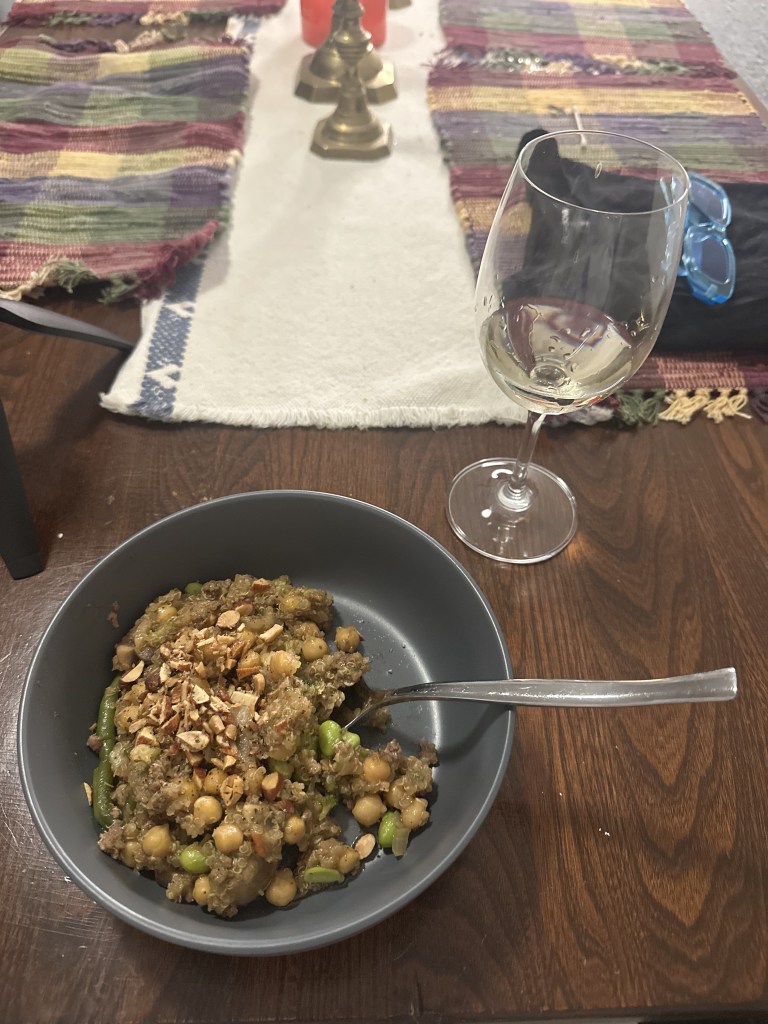
Maybe not the prettiest dish, and I could probably work on my food photography skills, but you can see all the lovely green vegetables in there, the chickpeas, and the chopped almonds.

This recipe made me 4 large glass meal prep containers full of leftovers. I will likely be eating this for lunch and dinner the next few days to make sure nothing goes to waste.

It is amazing just how tasty this is, considering how simple it is to make! This will be added to my rotation of simple, healthy meals that can be shared with friends or packed away for lunches and dinners throughout the week.

If you try this, let me know! I would love to see how you remix the recipe and what you are able to clear out of your freezer.

Workout Diary: January 24 – Feb 24

It has been a hot minute since I posted my last workout diary, so I figured it was time to update all of you on what I have been up to at the gym, what I am struggling with, and some of the new things I have added to my life to support my health and fitness goals.

Workouts

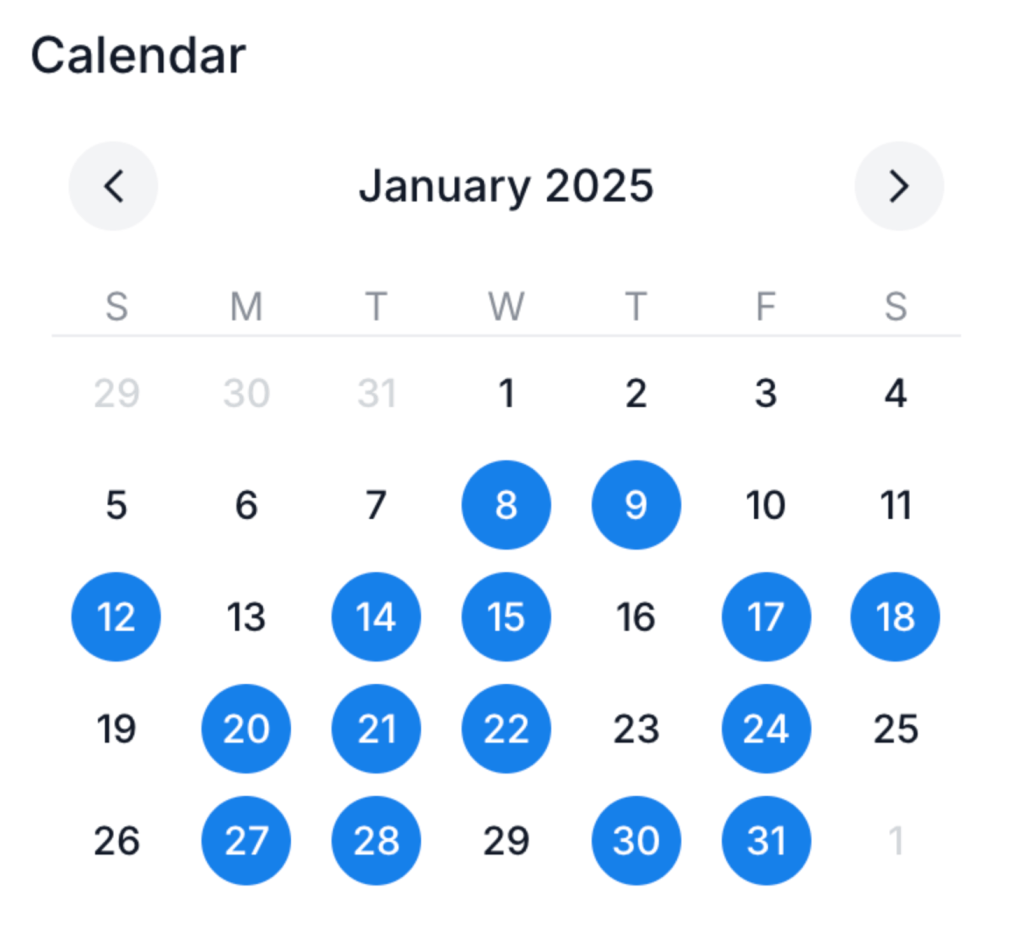
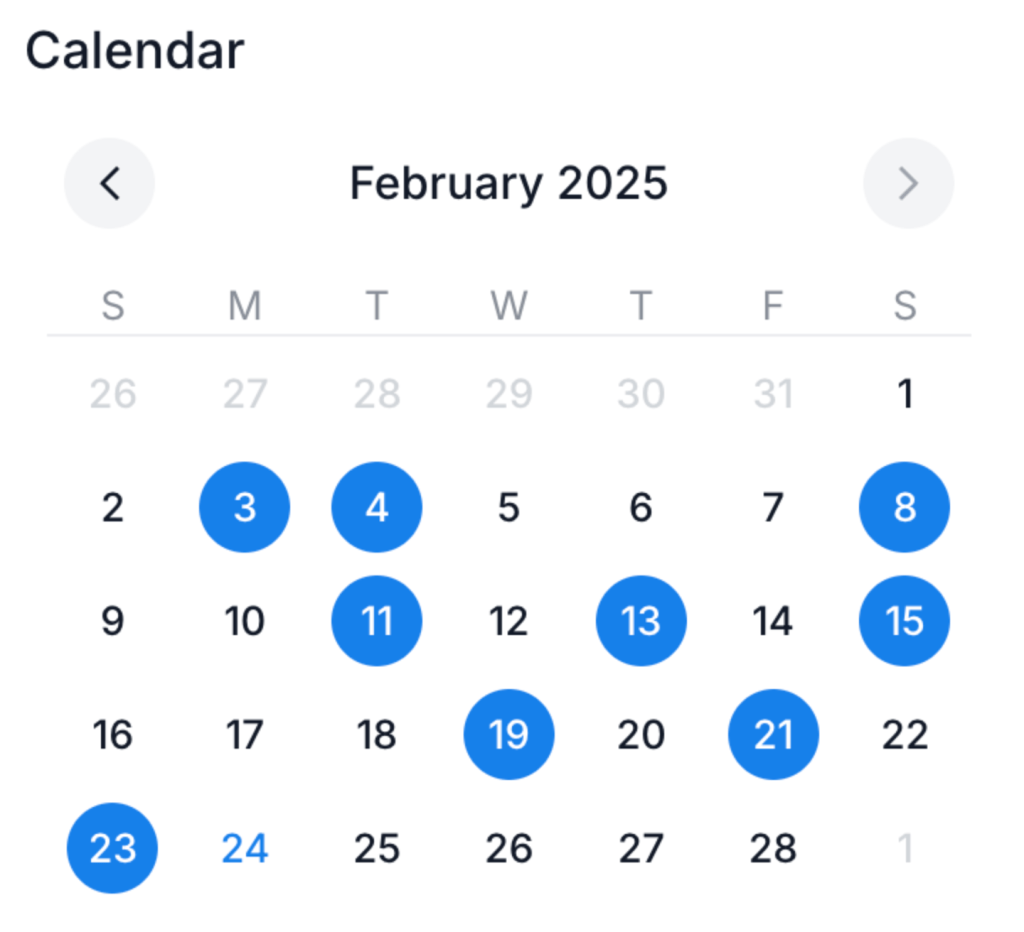
I am very happy to say that I have been to the gym at least twice every week since my last update. It’s been really important for me to stay consistent, even when I have been traveling for work or to visit family, which is all I’ve been doing since my last update.

You can see below when I was at the gym in the last month, all tracked on Hevy, of course.

January 26 – February 1

After my last update, I was able to get to the gym 4 times, which is the goal. It was also a “perfect” week for me as I followed the schedule that I find feels the best for my body. Squats and chest on Monday and Tuesday, a rest day on Wednesday, and then deadlifts and back on Thursday and Friday, respectively.

February 2 – February 8: Vegas

The following week I was actually in Vegas for a work conference, but I made sure to book a hotel with a good gym. I was staying at the Bellagio, which has a great gym. I didn’t take any pictures (sorry), but have included the pictures from their website below:

Source

This picture above is taken from the far end of the gym in the stretching or calisthenics area. The bikes were all Peloton bikes, which I thought was really cool and a great value-add to the guests staying there. Just beyond the benches you can see in this image, there was a good selection of machines.

I knew that the travel would likely impact the rest of my workouts for the week, so I put together a posterior chain and anterior chain workout for the mornings I worked out in Vegas.

Posterior chain and anterior chain are just another way of saying I did a pull day and a push day, or I trained the muscles on the back of my body, and the muscles on the front of my body.

If you know you can fit in 2 workouts, this is a great way to workout the whole body, and a fun way to change things up from splitting your workouts between up and lower body.

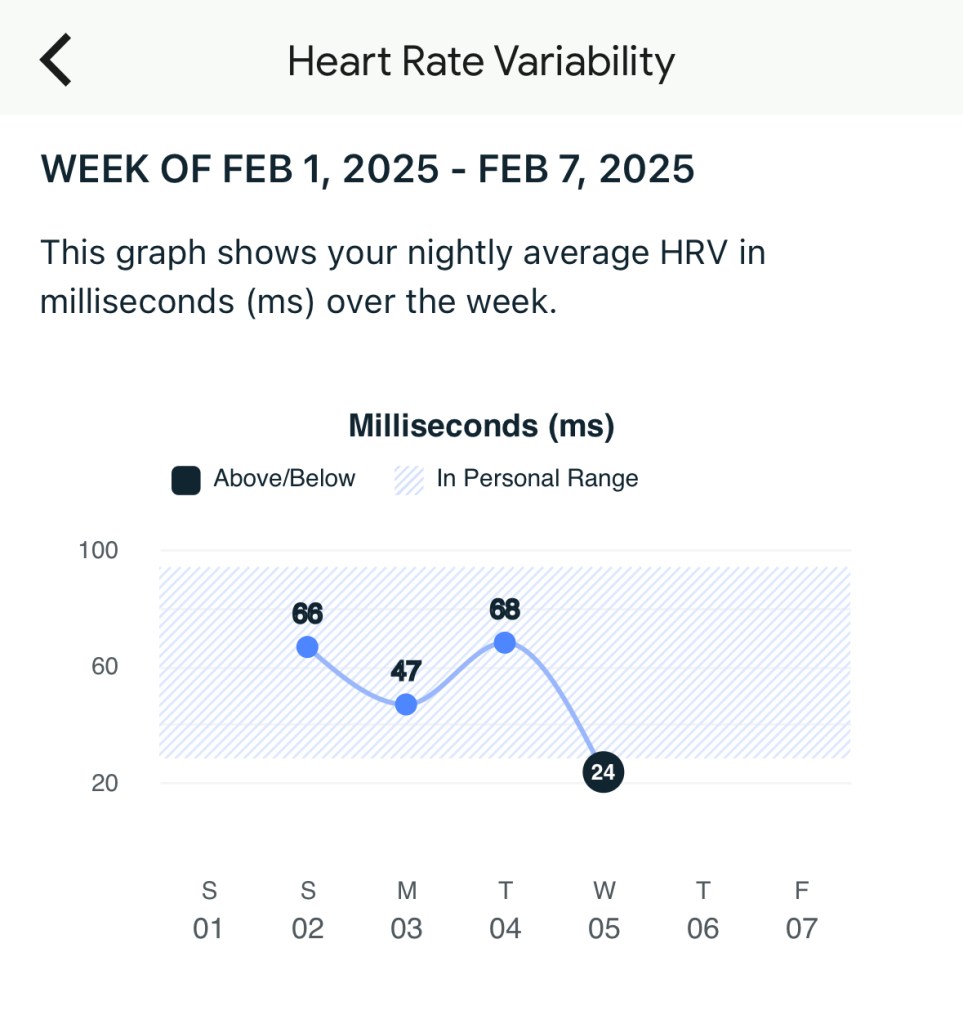
When I got back from Vegas I was exhausted. A busy couple of days working, a couple late nights, and a red-eye flight made Thursday and Friday of that week a write-off for me. The impact of travel and jet lag can be seen in my heart-rate-variability data that I keep track of in my FitBit app.

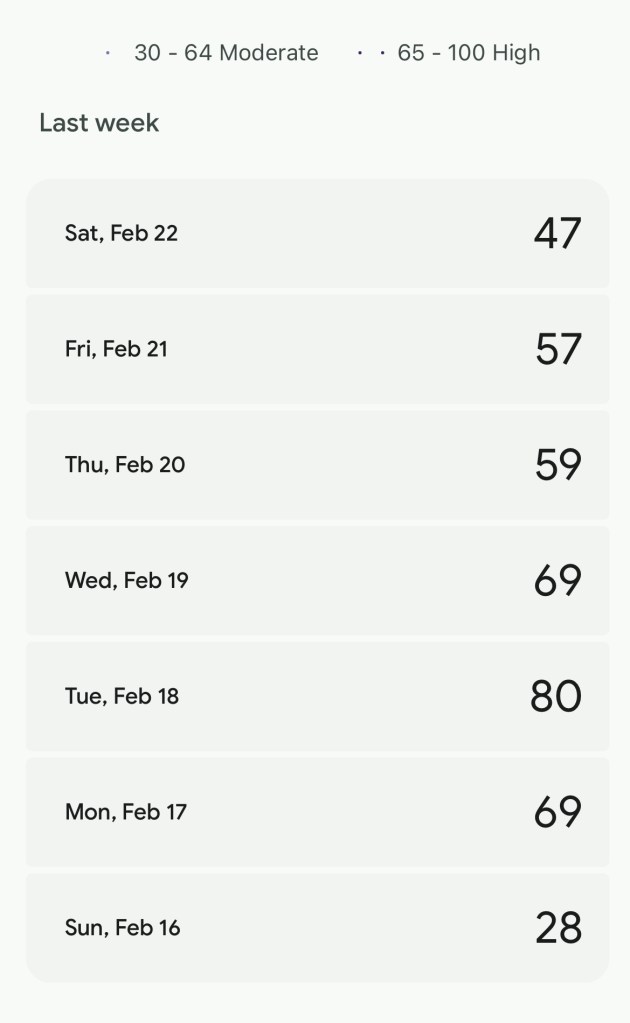
On the left is my HRV from the week in Vegas. Not bad on the first day, but it was definitely low. And then Wednesday it tanked to 24. I had my watch off Thursday and Friday, so I am missing that data, but a low HRV is a good sign that the body is less resilient to stress and therefore rest is needed. I’ve included my HRV from my last follicular/ovulation week in January where you can see my HRV is much more steady and even reaches a peak of 90ms.

I was able to get to the gym on the Saturday, but it was a slower workout. I didn’t know it then, but I was fighting off a cold or something that I likely picked up from all of the folks who were coughing on the plane ride home from Vegas. I really need to start packing my mask in my travel bag again!

February 9-15: A new gym

The following week was, of course, slower because I was fighting off a cold, but I still managed to get to the gym (and thoroughly wipe down equipment/apply hand sanitizer!).

The workout on Tuesday was at my gym, but on Thursday morning I traveled to Ottawa to visit my sister for 10 days. My sister has always kept a great training routine, and I actually got her and her friends onto the Hevy app so we can all keep each other accountable.

The Thursday when I arrived, my sister let me know that I’d be able to train at their gym when they go in the evenings. I have spoken about this before, but I am usually a morning gym girlie. I love the way it sets up my day and gets my brain right before I have to go to work. But, I figured I would try being flexible and adapt to their training schedule while I was staying with them.

The equipment was a different brand from what I am used to, so I had to modify some of the exercises to suit the equipment I was using. For example, when I am using the leg extension machine at my regular gym, I have been able to lift 100lbs, but at my sister’s gym, I was only able to do 35lbs. That’s a massive difference, but this isn’t something to discourage me.

The same weight will feel different from one brand to the next based on how they’ve set-up the seat, how much you can modify in terms of the position of the different moving pieces, how heavy the parts are, and even how many pulleys are used in the system. With the older equipment at my sister’s gym, I think it was a combination of the actual machine being made of heavier materials, fewer pulleys in the system, and the fact that the only thing I could move was the back of the seat.

Safe to say I am excited to be back in my gym this week.

February 16 – 23

This past week I was really grateful to have my sister and her friends there to keep me motivated because I was really starting to feel tired from a number of late nights and operating on a different schedule than I am used to.

I am an early morning girl, but everyone I was living with were night owls so I was staying up with them, but still getting up at my regular time (between 5AM and 7AM). Again, you can see from my readiness scores from last week that I wasn’t really ready to workout until the Tuesday, but actually training on the Tuesday ended up tanking my scores for the rest of the week. So it was challenging to get in there and do my workouts, but with the help of accountability buddies, I got there.

It is also important to note that, had I not taken my next package of birth control, this would have been my luteal and menstruation week in my phase, so it is normal to be tired and to feel a little weaker during this week.

Week 4-7 Recap

The biggest takeaway from the past few weeks is that life is very rarely consistent. It is hard to wake up every day, every week and know that you will have the same energy or environment to train in.

As busy women, we are traveling for work, going out with friends, and spending time with loved ones, and sometimes that means you have to modify your workouts based on time, energy levels, or the equipment available to you. But if you build up good habits during the times when you can keep up with your regular routine, you’ll be in a better position to be more adaptable to changes.

I am personally really proud of myself for being on my 10-week streak. There were times in 2024 where I would go 2 sometimes 3 weeks without getting to the gym, and when I look back on last year, I know that those inconsistencies really impacted my physical and mental wellbeing.

Although I am really proud of the good exercise habits I have built, I am still struggling with my eating habits, which I really want to focus on these next few weeks.

Current Challenges: Eating Habits

I want to be very transparent with you and let you know that I really struggle with staying consistent when it comes to eating food that fuels my goals. I don’t strive for a perfect diet, but I also know that only having coffee, and then McDonald’s takeout isn’t a great way to fuel my body, but sometimes that’s what happens.

A few things have impacted my mental state around food since the start of the year. I’ve been sick, I’ve been traveling, and I’ve been stressed about my budget.

When I am sick, I either have no appetite, so I will just eat the bare minimum and whatever I can eat quickly. I don’t have the energy to prepare a good meal so I go for things like peanut butter on toast, yogurt and berries, and whatever can be delivered to me in 30 minutes or less. Thankfully I do take a range of supplements that help me get more nutrients during these periods, but I also struggle to take those consistently when I am sick.

When I travel, I am at the mercy of whatever restaurants or cafes are nearby because I can’t cook for myself in my hotel room. Being in Vegas, especially the week when the tariffs were supposed to be announced, the cost of a simple meal was shocking. So now not only am I relying on food prepared by someone else, but I am also having to look for cost-effective options so I get the most calories for the fewest dollars.

And on that note, money is a huge impact on my mental state when I thinking about food. As a single person, I worry about buying ingredients for something, and the food going bad and therefore I waste good ingredients. I also always plan my meals around a source of meat protein for my dinner. The cost of meat has gone up significantly here in Canada, so I am constantly worried about if I’ll have enough or if I’ll blow my grocery budget on protein because I want to have a certain recipe prepared this week.

I love cooking, and I have a lot of knowledge about what kinds of food fuel my body best when I have a specific training goal. So you would think that eating is one of the easier parts of my healthy lifestyle, but it is actually one of my primary sources of stress and therefore how I end up taking 2 steps back when I have taken a great leap forward.

But, I don’t want this to continue to control my life. So I am going to be taking very intentional steps to make sure that work through the anxiety I feel around grocery shopping and my budget, so that I can benefit from delicious, home-cooked meals that are supporting all the good work I’ve been doing in the gym.

As I mentioned before, I am taking a handful of supplements right now that do give me some peace of mind that I am getting enough essential nutrients, even on the days where I am not eating the best food.

New Supplements in my Stack

I recently partnered with the Canadian brand, Organika, after years of using their supplements. I am also happy to offer you 25% off when you use code RILEY_25 on the organika website. I am also including Amazon associate links for Organika, but you won’t be able to use the discount code on Amazon.

I have repurchased a couple of items and added 2 new supplements to my stack from Organika.

Repurchased

Enhanced Collagen Protein Power Greens

I wanted to try a greens supplement because I know I don’t eat enough greens in my diet. The flavour is good and I usually combine this with my spirulina supplement to make what I like to call my “glow water”.

Spirulina + B12

As I just mentioned, this spirulina has been combined with my greens powder to really give me all the anti-oxidants I could need in a day. This is also a great plant-derived source of iron. Along with the dose of B12, this is a great supplement for vegans!

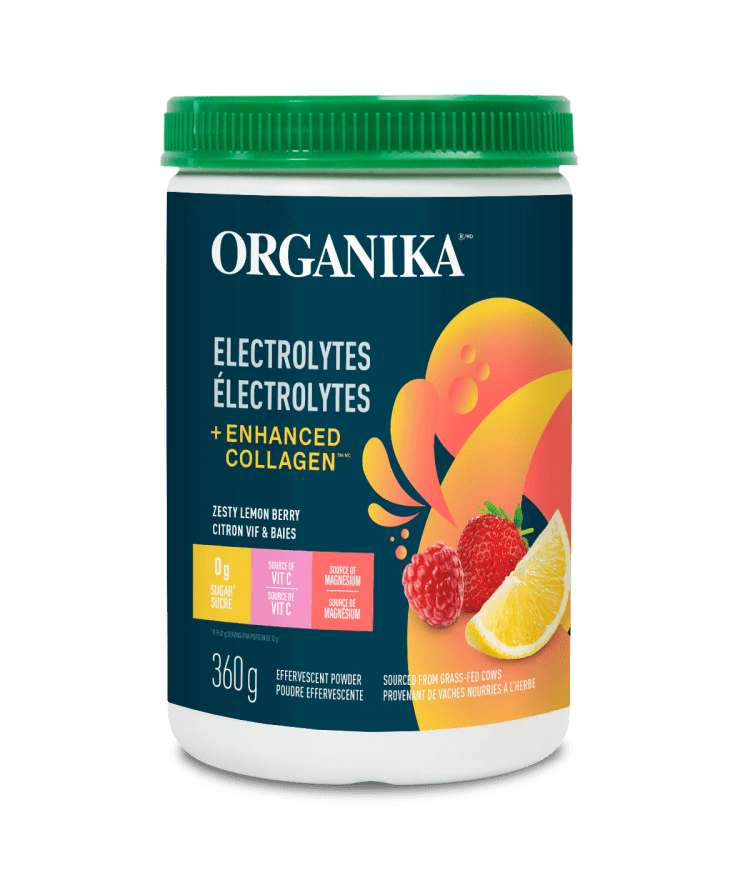
Electrolytes + Enhanced Collagen in Zesty Lemon Berry

When I go to the gym in the morning, I take a preworkout before I leave, and then a refill my water bottle with these electrolytes to keep me hydrated during my workout. The enhanced collagen is also a good way to get some protein in at the start of my day.

Chicken Bone Broth Protein Powder

There’s a ton of research on the benefits of bone broth, so I like knowing that I am getting a healthy source of protein and minerals to support my gut health and joints. This is really nice as a warm drink in the winter when I get back from my workout.

New Products

Full Body Enhanced Collagen Protein

I am starting to feel like I need to add a protein powder back into my routine. It is such an easy and tasty way for me to hit my protein goals, so I decided to test this out to see how my body reacts to it. My main concern going into this test is how it will affect my skin, but I think because it is collagen-peptides, it shouldn’t make me break out the way whey proteins do.

Metaboost Fat Metabolizing Complex Capsules

This was a major impulse buy from me. I think in a moment of insecurity I thought I would try another l-carnitine supplement. I have tried these supplements before, and all they do is make my heart race and make me anxious.

But I trust Organika, so I thought I would try their version, which includes other ingredients like garcinia cambogia and chromium. I’ll report back on this after using the full 15-day supply.

I am also trying a new gut health supplement from Blume health. I purchased their Super Belly purely because I didn’t bring any of my supplements with me when I was visiting my sister, and I was feeling like I needed a gut reset and additional hydration throughout the day. This package includes 15 sachets, and I am already almost finished them because I shared with my sister.

I think these taste great and are great in a pinch when I don’t have my other supplements with me, but all the other supplements I take have me covered for gut health and hydration, so I likely won’t repurchase this anytime soon.

What’s Next?

Looking ahead to the next 3-4 weeks of the year, I am going to keep up my current training schedule and get the gym 4 times per week as often as I can.

As I mentioned before, I also really want to start working on the anxiety I feel when I have to go grocery shopping. I’d really like to work through those feelings and figure out a way to take the stress out of grocery shopping. I really believe that if I can get my eating habits in order, I’ll really start to see some amazing results.

I am also going to be trying a new supplement that I have just recently spoken about on my blog, IM8. This is an all-in-one supplement, and I am hoping that if it all goes well, it will help me cut down on the number of supplements I am buying on a monthly basis.

I am also going to be traveling at the end of March, so I’ll be preparing for travel to Europe where I’ll have to physically prepare myself for some serious jet-lag, change in temperatures, and potentially doing at-home workouts for the duration of my stay there.

I’m really looking forward to the upcoming weeks and think this is going to be a pivotal couple of weeks that will further solidify my exercise habits and routines, and keep me on this really great path I’ve been on these past few weeks.

How have the first 2 months of the year gone for you? Have you hit any bumps in the road on your health and fitness journey? Is there anything I can write about that would help you? Let me know in the comments below. I always love reading comments and getting your feedback.

Collagen: Super powered protein or just another buzz word

The health and fitness industry is full of trends (histamine resistance) and buzzwords like “cortisol face”, and lately I’ve heard many more people talking about collagen.

I have been very clear that I approach all of these trends with a high level of skepticism because not only have I worked in the industry and tried many of these trends, but I also work in marketing and know that these buzzwords are critical to selling more products.

So when I heard collagen being thrown around the internet, I was interested in investigating the latest research and opinions online to see what all the hype was about.

In this article I’ll cover what collagen is and its role in the body; what forms of collagen supplements are available; and what the research is saying about the efficacy of supplementing collagen.

What is Collagen?

Collagen is the most abundant form of protein in your body, making up about 30% of all proteins.

This becomes obvious when you learn that collagen’s main role is to help provide structure and protection to organs like your skin (the largest organ of the body), hair, nails, and connective tissue like tendons and ligaments.

Amino Acids, the Building Blocks of Proteins

As with all forms of protein, collagen is made up of amino acids. These are the building blocks for all proteins and there are 20 total types of amino acids. Collagen is made up 3:

  • Glycine
  • Proline
  • Hydroxyproline

These amino acids are “conditionally essential” which means that under normal conditions, our body makes enough of them naturally, but during times like pregnancy, teenage growth spurts, and recovering from physical trauma (breaks, sprains, illness), the body does not make enough.

Thankfully all of these amino acids can be easily found in food sources like animal proteins and by products (meat, fish, eggs, liver) as well as plant sources like mushrooms, cabbage, and peanuts.

What Happens when we don’t make enough?

When we don’t have enough collagen, or, as our body naturally makes less and breaks down more as we age, the skin becomes less supple and saggy, connective tissue loses some of it’s strength, and our eye sight begins with weaken.

We can also see collagen break down due to lifestyle choices. Smoking, consuming products high in sugars and processed fats, and too much exposure to UV radiation without sunscreen can all impact the production of collagen and break down the existing collagen.

So for those of us who want to maintain a healthy amount of protein in our bodies to support healthy skin and strong connective tissue, is a supplement worth it or can we stick to a balanced diet?

What forms of collagen supplements are available?

You can buy collagen supplements in the standard forms of liquid, capsule, or powder. But the actual form of the collagen is most important.

The type of collagen supplement that is currently seen as the best, and most easily absorbed collagen supplement is hydrolyzed collagen, or collagen peptides.

Hydrolyzed just means they have used water to break the collagen molecule into smaller components (peptides). A peptide is a combination of two or more amino acids. The peptide makeup is what is crucial to allow the collagen to be broken down and absorbed by the body.

The reason they do this is because the collagen molecule cannot be absorbed in its full form. Your body needs to have the building blocks in order to decide what type of collagen it will make and where that collagen will ultimately end up in the body.

This is one of the beautiful things about the body is that we can buy things based on the marketing messages, but ultimately the body will decide the best use for those collagen peptides.

As I mentioned before, collagen is made up of 3 conditionally essential amino acids. So when we consume collagen supplements, the body will break those down into amino acids, and then depending on the area of the body that is most in need of collagen, the body will synthesize that type of collagen first.

When it comes time to choose your collagen supplement, you now know that hydrolyzed collagen or collagen peptides are the way to go. To help you choose the format of your supplement, here’s a quick review of the ways you can take collagen:

  • Capsules: these are quick and convenient to take and typically have a long shelf life so they can be bought in bulk. The downsides include varied absorption rates due to your body’s ability to break down the capsule, and the common practice of including fillers in capsule products.
  • Powders: these have a slightly shorter shelf life, but are typically told in quantities that will maintain their potency (30-day quantity, for example). Absorption is better than capsules, and reputable brands will clearly indicate what they included in the powder supplement. Finding a powder that you enjoy the taste of will also help you stay consistent.
  • Liquid: liquid supplements have the best absorption rate but the shortest shelf-life, so missing days or storing it incorrectly can impact the potency of the supplement. The taste can also be a deterrent, making it less pleasant to take the supplement every day.

I typically prefer taking my collagen supplements in powder form so I can control taste, it last longer, and I know exactly what is in the supplement. It also helps me stay hydrated throughout the day.

Is Collagen an Effective Supplement

Ok, so you know what collagen does in the body, where to find it naturally, and what to look for when buying a collagen supplement. Now it’s time to answer the important question: is collagen an effective supplement?

One of my favourite ways to start my research into supplement efficacy is to look at a systematic review. These are research papers that review multiple studies and compile the results of all of those studies into one succinct summary.

From there, I’ll dig into specific research to better understand the concepts and results that were discussed in the review.

Enough about my research method though. Let’s look at the research on collagen supplements.

In this systematic review of oral collagen supplementation, they found that across 11 studies, with over 800 participants, tripeptide collagen supplementation improved the look and hydration of their skin, and dipeptide collagen improved joint health.

Tri- and dipeptide just means that the collagen was broken down into the 3 amino acids or 2 out of the 3 amino acids.

So there is clearly some evidence that these supplements can be used to help improve the appearance of your skin, and may improve the health and resilience of your joints.

Final Thoughts

In my opinion, our bodies can get everything we need from a balanced diet. But there are folks with dietary restrictions, allergies, or who don’t eat animal products. Additionally, our body’s ability to absorb nutrients decreases as we age, so supplementing can be helpful then too.

I have also talked about how I take supplements as both a habit-forming tool and as an insurance policy. Taking collagen supplements not only supports my healthy habit of going to the gym and staying hydrated, but I also know that on days when I don’t eat enough protein, the supplement will “pick up the slack”.

Personally, I am a big fan of Organika’s collagen supplements because they are Canadian, they are transparent with their ingredients and how their products have been tested, and I have found powders that actually taste good.

Organika Electrolytes with Collagen, my favourite way to take them. Source.

For you, I hope that this article has helped you understand why collagen is being talked about in the fitness industry. I also hope that you were able to read this and decide whether or not collagen is actually necessary for your current lifestyle and your health and wellness goals.

If you have decided that you want to add a collagen supplement to your diet, then I recommend Organika if you are in Canada. You can get 25% off with my code RILEY_25.

Please note that this article was not sponsored by Organika, and they did not ask me to write this article. This actually came to me when a friend told me that her colleagues were talking about it and had heard some wildly false claims about collagen. So I thought it would be helpful.

If you are based in the US, then I recommend Snap Supplements’ Collagen and Greens. Their claims and price point are very similar to Organika.

What do you think about collagen supplements? Have you had a positive or negative experience? Let me know in the comment section below!

IM8: The New All-In-One Supplement

Black Friday Deal: 30% Off 60-Day Subscription + Limited Edition Mixer

If you have engaged with any supplement brand online, have been following sports nutrition influencers like Ben Greenfield, or are just a fan of David Beckham, then you have probably heard of IM8. It’s currently the only (legitimate) competitor to AG1 (Athletic Greens 1) and boasts a wide range of impressive benefits, including a heavy-hitting group of scientists that stand by this supplement.

In this article, I want to introduce you to IM8, share my initial thoughts on the supplement, and ultimately help you decide if IM8 is a good fit for your 2026 health journey.

What is IM8?

IM8, pronounced “I Am Eight”, is a company that has developed daily, all-in-one supplements for optimal health and longevity.

The Daily Ultimate Essentials: All-in-One Supplement is the evolution of the classic multi-vitamin. It comes in a powder and can be purchased in their forever container for a one-time fee of $146 CAD, or the subscription is $116 CAD/mo. You can also purchase the supplement in sachets for $165 CAD for the one-time purchase, or $131 CAD on their monthly subscription. The flavour is acai and mixed berries, and they present the taste of this powder as one of their major selling features.

See my IM8 Taste Test & Initial Thoughts Here.

They also originally sold a longevity capsule, but are currently working on updating the formula to a drinkable powder, similar to their daily supplement. The science behind longevity products is complex, but with the backing of Prenetics, this supplement includes a patent-pending ingredient that will rejuvenate the cells and target the natural process of cellular ageing.

Again, the science behind ageing is complex and widely researched, but it is also still one of life’s unsolved mysteries. Scientists are always looking for the “fountain of youth”, but given the fact that IM8 is backed by scientists from the top longevity research centers, as well as Prenetics, which specializes in genetic research, they are coming from a strong place.

The new formula is still in the works, but as soon as it comes available, I’ll be sure to update this article with more information.

If you end up loving this product, you can also get yourself some fun IM8 merchandise.

The Research and Results

If you have read my previous blog from March 2024 on supplements, then you’ll know that I am very particular about my supplements. As a trained fitness professional, with a lifetime of testing and observing supplements’ impact on my health, I am very skeptical of these all-in-one supplements.

So when I first saw IM8 comparing themselves to AG1, I knew I had to do a deep dive into the brand, but mostly their research and the results they’re sharing from that preliminary research.

AG1 – How Does it Compare to IM8

For starters, AG1, or Athletic Greens, is a greens powder that has been backed by industry heavy hitters like Andrew Huberman, who runs one of the top health podcasts in the world and has a portfolio of published research and more than 1 PhD (which is a big deal).

AG1 has been the dominant powder supplement for quite some time and hasn’t really been challenged by another supplement company in terms of testimonials or research results. Their focus is on gut health, and they also offer a vitamin D3 and K2 supplement.

I have tried a lot of greens supplements, so I wasn’t keen on trying this one because of the cost, but my mom ended up buying a subscription and although she liked knowing that she was getting all the greens she needed in one supplement, she said the taste wasn’t pleasant, and believed she could get a similar supplement for a lower cost.

Personally, AG1 was never able to get me as a customer because I knew I could get good alternatives for each of the benefits they were promoting.

IM8 is New and Different

As I mentioned at the beginning of this blog, IM8 has been everywhere lately. I can’t go online without seeing a review, an unboxing, or a video of David Beckham talking about his new product.

One of the key images that grabbed my attention was the one below:

Source

It takes direct aim at AG1 and does a great job of highlighting how many incredible ingredients and benefits have been packed into IM8. As a skeptic of all-in-one supplements, this chart above really made me want to know more.

Specifically, how they managed to maintain the potency of all of those important ingredients and ensured that they didn’t lose that potency in the manufacturing process or when the product is ultimately mixed with water. This is a common issue with multi-vitamin supplements; after sitting on the shelf, or once they’ve been mixed with water, you actually lose a lot of the potency and nutritional value.

So, how has IM8 developed a product that combats this and actually offers consumers something new and effective? Let’s get into it.

IM8 is All About Research

They have a stacked advisory board of scientists, including a former NASA Chief Scientist, an Integrative Oncologist from the Mayo Clinic, and the founding Director of the Yale-Griffin Prevention Research Center.

Each of them is bringing their own expertise to this company to develop products that are effective and potent enough to actually have an impact on daily health and promote longevity.

With a great group of scientists working on this product, naturally, they are also incredibly thorough with their research. The dosage of the key ingredients in both products has been third-party-tested, which means that an outside firm is conducting the research to determine the efficacy of this product.

You can see the results of the dosage certifications here.

Regarding the claims from users of the product, the clinical trial is still underway, but they do have early qualitative results from those participants, and they are transparent about this as well. You can see in the fine print of this section of the website that these are interim results.

You can look into the actual study design here. The study ran between October 2024 and March 2025, with the final results presented in June 2025.

As I mentioned earlier, IM8 is a science-backed nutrition brand co-founded by David Beckham, a world-class athlete who had access to top health professionals throughout his career. Recognizing the need for a strong partnership, he teamed up with Prenetics, a global health and genetics company specializing in prevention and early detection, to create a world-class product.

If you look into the trials, you’ll see that Prenetics is sponsoring the trials, but this does not mean they are performing the actual research. They’ve simply provided the resources for the team of researchers to complete the study.

The interim results are positive and do give me confidence in the product, but of course, I will need to try it for myself before I can say whether or not I will be adding it to my daily wellness routine long-term.

Final Thoughts

I have done a thorough deep-dive into the IM8 website and wanted to summarize my initial observations and thoughts on the products for those of you who, like me, have been inundated with IM8 content on social media.

As mentioned in the beginning, I am skeptical of these types of products, but after doing lots of research, reviewing their research, claims, and their ingredients, I am interested in trying this product to see if I also experience the energy, bloating, and hair/skin/nails benefits that the research participants have experienced. Anything that has the potential to improve all of those in one supplement would definitely be a time saver for me and would give me peace of mind. Not to mention I could save a lot of money buying 1 product instead of 6+.

If you’re interested in testing this product for yourself, they are running a launch special where you can get a free starter pack along with your subscription purchase. If you’ve already tried IM8, I’d love to know what your experience has been! Leave your comments below to let us know what your experience has been with this revolutionary product.

Are Wearables Worth It?

The rise of wearable fitness trackers has been like the rise of many new technologies. For years people counted on the calories on the screen of our treadmills, and heart rate monitors that wrapped around our chests, but when FitBit launched it’s first wear fitness tracker, we entered a new age of fitness-related data.

Since then we’ve seen this market explode. From watches, to rings, to innovative trackers like the WHOOP band, there are so many ways to tap into your physical data to better understand your activity levels, sleep, fertility, and even see yourself getting sick before the symptoms really hit you.

But is this tech really worth it? Should you be investing in something that sits outside your body to tell you if you’re ready to train, or if you got a certain amount of REM sleep? I am going to dive into this topic from the perspective of a personal trainer, but also a consumer of wearable tech.

Are They Worth It – From a Personal Trainer’s Perspective

When you hire a personal trainer, you are hiring someone to take in all the qualitative data about your health (exercise history, experience with exercise, feelings towards diets, etc.), combine it with limited quantitative data (weight, bodyfat %, body measurements) and put together a workout plan that helps you achieve your fitness goal.

As a personal trainer, I would always do my best to assess the client’s energy levels before the workout, and keep an eye on them during the workout to ensure I was respecting their body’s response to the exercises. But observation is never a perfect system in this situation.

Truthfully, when I was a personal trainer I always wished that I had access to my client’s fitness tracker dashboards. To see how physically active they are outside of our 30 minute – 1 hour sessions would be a gold mine of information. Better yet, if they tracked what they were eating as well, I could offer more tailored advice to them. And of course, if I understood their sleep patterns, I could also personalize their program even further knowing how sleep impacts readiness, stress, and recovery.

There’s one caveat though – my client would need to be tracking perfectly for any of this information to be truly useful. The main issue, in my professional opinion is that you always have to wearing the wearables in order to get the best data analysis from them.

WHOOP Band, Recommended by Personal Trainers (and Elite Athletes)

I think that’s why I believe that the WHOOP band has been really well designed, with constant tracking in mind. When they designed the WHOOP band, they made sure to design a portable, waterproof charger that could be attached to the band, instead of having to remove the band to charge it, only to forget that you left it on the charger and have now lost a day’s worth of data.

So as a personal trainer, I would recommend my clients get the WHOOP band.

Although it feels like WHOOP has thought of everything, including plenty of colour options, a portable charger, a well-designed and intuitive app, clever marketing, and clothing designed to fit the WHOOP tracker, there is one challenge: the cost.

WHOOP is a great business because they decided to follow in the OURA ring‘s footsteps (no pun intended) and offer the WHOOP band on a subscription model. So you’re paying for your band, and then paying a monthly or annual subscription fee to access their app and accessories and upgrades, should you choose that subscription level.

They are offering a trial period, which I think is a great way to get more people using the device, but if this is out of your budget before the trial period, it will likely be out of your budget after the trial period – you’ll just be more sad about it after.

Ultrahuman Ring and OURA Ring

As mentioned above, the OURA ring is another wearable on the market that offers great tracking and a new way to wear our fitness trackers. However, recently, the Ultrahuman Ring has been making a splash in the health and wellness space.

In the last 3 months I have found that more and more people and fitness enthusiasts have been talking about how they prefer the Ultrahuman Ring over the OURA ring.

Let’s face it, all of these more premium style trackers are going to be offering the same data. Things like sleep tracking, heart rate variability, physical activity, temperature and an app that helps make sense of the data. The thing with the Ultrahuman that is making it stand out from the OURA ring is the fact that it is a one-time fee.

That’s right. Just buy your ring for $349 ($120 less than the latest OURA ring) and that’s it. You get access to their app and all of the amazing technology in the band.

Again, as a personal trainer, I like these types of fitness trackers because I find the quality of the data is so much better. I have been a long-time Fitbit user, and have plenty of friends with Apple watches and Garmin’s, and all of these are great, but I have always found that they lack high quality tracking.

Before I move onto my recommendations based on being a consumer of these products, I just want to say that although rings are a great option, they can get in the way when you are lifting weights. Lots of people complain that the pressure on the ring hurts, or is uncomfortable during exercises like deadlifts and bench press.

Are Wearables Worth It for the Everyday Consumer

Now that I am in the world as someone who works out before my day job, instead of working out being my day job, my perspective on wearables has shifted. I may still be a data-junkie who would love to invest in a WHOOP band and and Ultrahuman ring, but that isn’t the most common experience for everyday folks who are looking to stay active and stay motivated with the help of a fitness tracker.

For the majority of people, having a step counter will actually suffice. And this isn’t to minimize people’s fitness goals, it is the truth. When I go see my friends for an event like a festival, or after a big day of walking around the city, the number one thing people are comparing is their step count.

Step count is a simple way to see how active you’ve been throughout the day, and in a society that is increasingly sedentary, I genuinely believe that having a device with a fairly accurate step counter will do the trick. In the video below you can see the creator tests common fitness watches to see which one tracks 1,000 steps the most accurately.

From this video, you can see that the Pixel Watch 2 got the closest to the actual number of steps taken by the creator. It is worth mentioning the Google, who makes the Pixel watch, also purchased Fitbit, so I think both are good options if you’re looking for a wearable fitness tracker that will give you all the basic information you need, with a user-friendly dashboard in their app.

I have to confess that I really love Google’s Pixel lineup of products. I bought the Pixel 2 phone back in the day and loved it and would truthfully buy it again if I wasn’t committed to the iPhone due to my social circle all owning iPhones.

I also was very close to buying a Pixel watch last spring when I was looking to replace my Fitbit Versa 2 that had been damaged. However, due to my budget constraints at the time, I decided to go with a Fitbit Versa 4 over the Pixel watch.

And again, as someone who is now just getting to the gym as part of my daily routine to keep myself in shape, a wearable watch like the Fitbit, Pixel watch, Apple watch or the Garmin vivo series are great. They’ll track physical activity, they typically have different exercises you can track on the watch and in their app, they have great features like timers, alarms, and activity reminders, and tick all the boxes that the general population would look for in a fitness tracker.

In conclusion: What Wearable is Worth it to YOU?

Wearables in the fitness industry really have changed the way we think about and track our health and wellness efforts. I think from both a personal trainer standpoint, and from the perspective of someone who cares about human health, the fact that we have these devices available to us is amazing.

I think with all technology and anything that stores data, we have to be mindful of the fact that major corporations have our health data, but if this is something that truly concerns you then there are ways to protect yourself.

Which leads me to my concluding statement: wearables are worth it depending on the worth you place on having that data available to you.

For example, I really value having as much data as possible because I like the idea of fine-tuning my exercise, diet, sleep, etc. to see how it impacts my workouts. This is why the higher-end wearables with better tracking technology are worth the investment to me (when the budget is available). At the same time, buying the Fitbit versa 4 was worth investing in at the time, despite not having all the bells and whistles of the Ultrahuman Ring or WHOOP band, because I needed that basic data to keep me motivated when I was going to the gym.

If you are someone who likes the notification that says you’ve hit your steps or closed your rings for the day, then I do believe wearables are worth it for you. If you want to keep track of your after work run to see if you’re getting faster or running farther, then again, these wearable fitness trackers are definitely worth it because they make tracking that so easy.

Regardless of where you are at in your journey, wearables will always be an investment. So if we are talking about if they are worth it or not, then it ultimately comes down to what worth do you give your health data? My best friend is in great shape, stays active, eats well and has never worn a wearable fitness tracker in her life. She just doesn’t put value in the data. Whereas I am the total opposite.

With that in mind – do you value health data? Have you found wearable fitness trackers help or harm your fitness goals? Let me know in the comments below! I’d love to hear your thoughts on this.

My Current Haircare Routine

One of the things I’d like to start doing on my blog is writing more lifestyle content. After all, fitness and my workouts are just a small part of my day. There are so many other things I have implemented in my life to support a healthy mindset and a full life.

I was sitting around trying to think about what I wanted to talk about and what would actually be useful to you and as I’m sitting there, I’m twirling my very soft, very healthy hair.

And it dawned on me – why not share a quick post about how I’ve changed my haircare routine to support healthier, stronger hair that I feel confident in. As with all of my recommendation posts, this post includes affiliate links. I made sure all links are from amazon so you can get everything you need from one shop, and I do appreciate you choosing to shop through these links. To learn more about affiliate links on my website, check out my affiliate page.

My Haircare Inspiration

For years I have just let my hair be. I gave myself haircuts in COVID with kitchen scissors, tried different hair masks, spent all kinds of money on shampoo and conditioner, and tried all the styling trends.

But truthfully, I never really stuff to a haircare routine. I thought for a long time that haircare was my sister’s thing, completely missing the fact that haircare is for everyone. I always admired how my sister took such great care of her hair, and she always got compliments on her hair, and I know that because she took the time to take care of her hair, that it was a source of confidence.

And I wanted to feel that too. I was done thinking “that’s for other people” or “I wish I had a haircare routine”. If I can wish it, I can have it.

As the internet does, I started to be bombarded with haircare content on TikTok (before I left the platform) and started to piece together a haircare routine that I thought could be sustainable and that I’d actually stick to.

Here is that haircare routine, along with my current styling tools.

Hair Tools

Shark Flex Styler for straight hairstyles

This was the year I hopped on the hair styler trend. In my holiday wishlist blog I mentioned that I would love the Dyson AirWrap, but I do not have $800 to spend on a hair tool. So this was the next best thing.

My hair is still struggling to hold the curls this creates, but it’s a journey. We’ll get there.

Conair Scalp Massage Brush

This is one of those things that I think is not entirely necessary, but I was committing to the routine and every girl with gorgeous hair had one of these scalp massagers.

The purpose is to stimulate blood flow to the scalp, which will help bring nutrients to the hair follicles and help your hair grow.

It also just feels really nice.

Silk Bonnet

This is another tool that isn’t necessary, but it is a nice to have to help protect your hair when you’re sleeping.

Also, with so many products in my hair, I don’t want that transferring to my pillow and then onto my skin.

So I have enjoyed this, but again, it isn’t a necessity. You can always put your hair in a braid instead.

Continuous Hairspray Bottle

This is another nice-to-have when you’re creating your haircare routine.

I mainly use it to dampen my hair before I put on my hair mask, instead of having to get in the shower to wet my hair, or awkwardly hand my head over the tub to get it wet.

Wet Hair Brush

The final tool is a wet hair brush. I have been ripping through wet hair with just about any comb I can find in my bathroom.

In the spirit of really buying into my haircare routine, I bought this $15 brush and am happier for it.

Haircare Products

Natural Castor Oil

Every haircare girlie talks about castor oil. I was actually introduced to it when I was looking for ways to heal a surgery scar.

Castor oil really does feel like a cure-all. In my haircare routine, I am still working on how I am applying it. It feels so sticky so I am still figuring out how to use it, but it works as a great carrier oil for my rosemary oil.

Rosemary Oil

The next thing in every haircare girlie’s routine is rosemary oil.

On wash day, or the night before washday, you combine your rosemary oil with castor oil and then massage it into your scalp using your fingers and the scalp massager.

Apparently, this helps stimulate hair growth and I have seen some pretty impressive results online.

OUAI Fine to Medium Hair Mask

Once your scalp is oiled and massaged, it is time for a mask.

Now this is the most expensive product in the routine and runs you up about $50. But it is worth it. OUAI creates really beautiful haircare that is worth the pricetag.

Of course, you can find another mask that suits your hair type and budget. I do love this one though.

Heat Protectant

Once you are out of the shower, it is time to dry your hair and protecting your hair from the heat is so important if you want to keep happy, healthy hair.

So I picked up this inexpensive, but effective heat protectant from L’Oreal and feel confident that my hair is protected.

SEEN Hair Serum

After you’ve washed your hair with your favorite shampoo and conditioner, you’ve dried your hair, and you’re just about ready to start your day, the final step is a hair serum.

I went with SEEN because these products were designed by a dermatologist who noticed that certain hair products were causing her to break out.

With my sensitive skin, I wanted a scalp serum that would be good for my skin.

My Favourite Releases from GymShark’s First Drop of 2025

If you don’t know already, we are GymShark stans in this household. I have tried so many different workout clothes and GymShark, since they upgraded the quality of their products around 2021, has been at the top of my list for years.

Affiliate Disclosure: Please note that this article contains affiliate links. This means that if you click through the links and make a purchase, I may earn a small commission from that purchase at no extra cost to you. To learn more about affiliate marketing and how I use the income from affiliate inks, check out my affiliate page.

One of the best things about GymShark is that they are a brand that keeps on giving. You get new colours, styles, cuts, and a diverse set of options depending on how you like to train. I also love that they’ve recently collabed with Leana Deeb, a Muslim content creator who advocates for Palestine, the Arab community, and inclusive sportswear for Muslim women, which is what her collab with GymShark is all about.

Leana Deeb’s Instagram Account

I am not a Muslim woman so this collection was not designed for me, and therefore I don’t feel right choosing my favourites from the collection. But I strongly encourage you to check it out if you’ve been looking for quality gym gear designed by a woman who understands how these garments need to perform.

Let’s get into some of the other new collections and new arrivals that are bringing that energy to the new year!

GymShark’s “Cool Running” Collection

I am not a winter runner, but who says you can’t stock up on your running outfits in the winter? I’m also starting running training now, on the treadmill, so that when summer comes around I am already pre-conditioned to join all the run clubs (and look cute doing it!)

Vital Seamless 2.0

I will be a vital seamless stan for as long as they make these shorts. Although these aren’t new, I can confirm they make a great running short. There are details on the sides that allow for more airflow so that you don’t get too hot when you’re running.

Also these shorts come in 9 colours and are available in XS to XXL. So you have options! I personally cannot imagine wearing anything but black when I am out running to avoid any crotch sweats.

However, I do think the other colours would look really cute for running errands, or maybe a yin yoga class.

Scallop Hem Shaped Shorts

Okay hear me out – these shorts are kind of giving like 80’s fitness trend and I am HERE FOR IT. I grew up playing soccer in these loose, somewhat oversized shorts (in the 90’s and 2000’s) so I would love to get a couple pairs of these for the summertime.

I can just see everyone in these this summer so you might as well get ahead of the trend now, because I know I will be.

Running Graphic Oversized T-Shirt

I am really in my workout t-shirt era again. In my holiday wish-list post I had a couple different training shirts there because all of my shirts are so outdated. They all have pit stains and I have probably had my current workout t-shirts for over 10 years.

So it is time to update our workout T’s. In the spirit of running more, why not get a t-shirt that announces it loud and proud.

I love how this looks fitted, but also breathable. It won’t be sticking to you immediately, and when you’re really running, you’ll get a good breeze in this shirt.

It also invites versatility. You could tuck the shirt in your shorts, in your sports bra, tie the shirt or wear it loose. There are only 3 colours available right now, but if I know GymShark, I know they’ll be releasing this shirt in more colours.

Running Skort (!!!)

Listen, I have a new-found obsession with skorts. And it isn’t even that new. I wrote a whole blog this past summer about the best skorts and shorts on the market and I stand by those recommendations.

So naturally I am including their skorts here. The colours options are definitely limited; I would love to see more options here that let me have girly, colourful days, as well as practical, all black skort days.

The thing that I really love about this skort is the fact that the skirt is cut above the back of the shorts underneath. It is such a Sabrina Carpenter, mini mini skirt vibe and it is so feminine and cute.

As a strong woman, who is built physically strong and viking/potato farmer genetics, these cute, feminine pieces are so important to have in my workout wardrobe.

Running Sports Bra

Quick storytime about me and running. When I was in my teens I used to run pretty regularly as part of my conditioning for soccer. One evening I was running through a neighbourhood that didn’t have sidewalks in an all black outfit, and a woman drove up beside me and told me that she almost ran me over because I didn’t have any reflective gear.

Although odd that she pulled over to tell me this, I am grateful for the life lesson. I always think about that moment whenever I see workout clothing with reflective materials, which is exactly why I am excited about this sports bra with reflective materials.

I don’t need a lot of support, but for my girls who do, this would be a great sports bra not only for support for also for safety!

The sports bra comes in black and white, and runs in sizes XXS – XXL.

Whitney Collection

Whitney Simmons has been a part of many millennial women’s fitness journeys. She’s been reminding us that it is a beautiful day to be alive, and always giving us the squat proof tests that we need.

She was recently announced as the creative director for their adapt line, and it seems she has made her first major move releasing the Whitney leggings, joggers, and 1/4 zip. In true Whitney fashion, the leggings are working overtime to show off your beautiful glutes, and the sweats and 1/4 zip are rest-day essentials.

The leggings come in 4 different colours. The joggers and 1/4 zip come in 3 colours. All items run from XXS – XXL. Whitney Simmons is a business woman so you know that these have been designed with quality in mind.

It’s always fun to check out the newest trending items, so I hope you’ve found something new that you’ll love in 2025. For now, I have to go plan my summer running program!

How to Use Prilepin’s Table

Whether I intended it or not, the theme of my blog this month is secrets, and one of the greatest tools in my personal trainer toolbox is Prilepin’s table. If you are looking to achieve your goals using tried-and-true science, or if you’ve heard of this table but don’t know how to use it, this is the blog for you.

What is Prilepin’s Table?

Prilepin’s table is a guide for weightlifting athletes designed by Alexander Sergeyevitch (A.S.) Prilepin, a weightlifting coach in the soviet union in the 70’s. He designed the table after years of observing the training journals of soviet weightlifters making note of the total reps and sets and how they related to the athlete’s 1 rep max (1RM).

Source

The efficacy of the table is widely debated in the fitness industry, but in my experience, I have been able to get great results for myself, my friends, family, and clients using this table.

The core use is to understand how many total reps across your sets you should be doing based on your 1 rep max. I’ve already written a blog all about rep, set and loads and how this relates to your training goals. I have also written about 1 rep-max, so you can check those out and come back if those are unfamiliar to you.

To give you the sparks notes, training using your 1 rep max is a reliable way to not only train safely but to really personalize your training to your current strength and fitness level.

When you tie in Prilepin’s table to your 1RM training you also unlock a common table used by most, if-not all professionally trained personal trainers. That’s the table below:

Training Reps, Sets, Rest and Intensity by Training Goal
Training GoalSetsRepsRestIntensity
Endurance3-4+12-20+0-30sup to 67% 1RM
Hypertrophy3-6+6-12+30-90s67% – 85% 1RM
Strength3-62-62-5 min85% – 100% 1RM
Power3-5+1-22-5 min80-90% 1RM

When you combine the two, you can create personal training programs for the rest of your life that are custom to you and will be using science to help you achieve your goals.

So let’s get into that!

How to use Prilepin’s Table

Let’s go through the table in detail. On the left-hand side you have your % of 1RM. This helps you understand that when you are (for example) training at 60% of your 1RM, your target reps per set between 3-6, your optimal total reps across all sets is 24, and your total range of reps is 18-30.

Source

Of course, to really start using this table you need to know your 1 rep max for each of your core lifts. You can really go deep and learn your 1RM for every exercise you plan, but I don’t think that’s necessary, especially right at the start. Just determine your 1RM for your key lifts:

  • Squat
  • Bench Press
  • Deadlift
  • Lat pull down
  • Seated Row
  • Overhead press

Once you have your 1RM, you can then look at the table and start thinking about what % of your 1RM you need to be training at based on your training goal. Again, I have a whole article about training goals, so go check that out for more info.

When you know that your goal is Hypertrophy, or growing your muscles, then you know from the table below that the rep range you want to be at is 6-12 reps, with a rest period of 30s – 90s.

Training Reps, Sets, Rest and Intensity by Training Goal
Training GoalSetsRepsRestIntensity
Endurance3-4+12-20+0-30sup to 67% 1RM
Hypertrophy3-6+6-12+30-90s67% – 85% 1RM
Strength3-62-62-5 min85% – 100% 1RM
Power3-5+1-22-5 min80-90% 1RM

Taking that information over to Prilepin’s table, you’ll need to be lifting between 67 – 85 % of your 1 RM.

The real benefit here is that you can feel confident that the weight you are lifting is specific to your current fitness level. No more going into the gym and thinking you want to increase your muscle definition (tone) and picking up a random weight that you think you can lift for 8-10 reps for 3-4 sets.

Now you know that if your 1RM for deadlifts is 150lbs, your 70% 1RM is 105lbs. So your Hypertrophy workout at 70% of your deadlift 1RM will need a total of 24 reps over 4 sets, or 8 reps for 3 sets at 105lbs.

The Results from Using Prilepin’s Table

As I mentioned before, the use of Prilepin’s table is debated in the fitness industry, but the results, in my experience, are really impressive. When I first graduated from my fitness and health program, I created workout programs for my family using this method, teaching each of them the theory of rep and sets for training goals, and how to do a 1RM test.

Every single family member who followed the program improved their 1RM over the 16-week program. My brother-in-law, who was a police officer at the time, shared the program with his brother, who was an arborist, and both of them increased their overall muscle mass, didn’t experience any overtraining injuries, and even received feedback from their doctors that they’d done enough to strengthen rotator cuff muscles that their shoulders were more resilient against dislocation (a common issue for both).

Knowing that training plans can be this detail-oriented is why I am always a little irked by the random workout plans that folks are posting on social media. They are great to get you started, but when you’re really dialed into achieving a specific training goal and doing so in a way that is unique to you, then this method of combining Prilepin’s table with the personal trainer table is what will get you there.

Please let me know if you have any questions about creating training plans using this method. I am always up for helping out, or pointing you in the direction of more great resources.

How to Make a Lower Body Workout like a Personal Trainer

As someone with formal education in exercise and physiology, I feel like I hold the secrets to make an effective, efficient workout. I am always happy to share tips to friends and family to help them make the most of their workouts, so I decided it was time I start sharing these same tips with you. After all, as a modern millennial woman, you have a lot going on so your workout needs to fit into your schedule and actually help you achieve your health and wellness goals.

So in this blog I am going to break down how you can make a lower body workout like a personal trainer would.

Step 1: Understanding Your Energy Systems

When you begin a workout your body has a couple different energy stores ready to support your workout. Many of you will likely know that carbs give you quick energy, fat stores energy, and protein helps you build muscle (and if you don’t you can check out this blog).

But our energy systems are much more complicated than that. To spare you from having to go down memory lane and recall your high school biology class, I’ll just let you know how I think about energy systems when I am putting together workouts.

Energy System 1: Quick/Explosive Energy. High power, but short-term source

The first system that your body will use in a workout is an explosive energy source. The energy converts quickly and helps us accelerate from not moving, to sprinting or jumping.

This energy system can be used to start your workout with exercises like box jumps, kettlebell swings, or even a sprinting workout on the treadmill.

However, because this energy source can be accessed and offers such a quick source of energy, it also runs out very quickly. This is why Olympic sprinters can go all out and sprint 100m in less than 10 seconds. This is an incredible feat, but not sustainable over long distances.

When I am creating a workout, I am not doing box jumps before my squat workouts, because I actually want to save this energy so I can start my workout with compound movements.

Which leads me to the next energy source.

Energy System 2: Powerful Energy. Medium power, medium source.

The second energy source is great for focusing your energy on the most important exercises of your workout. In the example of lower body workouts, I always make sure to plan squats, deadlifts, or leg press at the start of my workout.

This is because this is when I have the most of this powerful energy. I’ll be able to lift heavier, with better technique because I have saved this energy source for my compound lifts.

With this energy source, you typically want to take rest that is anywhere from 90s – 3 minutes. This allows the body and brain to recover, recuperate some of that energy, and be ready to give that same energy to your next set.

This energy helps you to lift heavy, so if you have goals to lift heavier weights, in the 4-8 rep range, then you really do want to put these at the beginning of your workout.

If you are planning a workout where you don’t want to lift too heavy, are going to take shorter breaks, and are going to be doing higher rep ranges (9+ reps/set), then you’ll benefit from the final energy source.

Energy Source 3: Endurance Energy. Low power, long-lasting source.

The final energy source is most commonly associated with exercises like long-distance running, swimming, or cycling. This energy source is incredible because it can last hours and helps marathoners and ultra-marathoners do the same exercise repeatedly for hours on end.

When you are planning a workout, you can trust that this energy source is always there. It is the final energy source to kick in and will help carry you to the end of your workout. This is why I typically save exercises with higher rep ranges, or my cardio for the end of my workout. I always know I’ll have the energy for it, and if I don’t then I am pushing beyond my current fitness level (and that’s okay!).

Energy Source Recap

To recap this section:

  • Energy Source 1: this is explosive energy. Great for the beginning of your workout when you need the most power for a low-rep, explosive exercise like box jumps, kettlebell swings, or sprinting. Rep ranges are low and rest required is anywhere between 3-5 minutes.
  • Energy Source 2: powerful energy. This is great for the beginning and middle section of your workout. Exercises are multi-joint, higher weight, lower rep range like squats, deadlifts, or leg presses. Rep ranges are between 4-8, rest is anywhere between 90s to 3 minutes, and weight should be challenging.
  • Energy Source 3: endurance energy. This is excellent energy to be called on at any point in your workout if you are lifting lighter weight, doing a repetitive exercise like running, cycling, or high rep exercises. Rep ranges are 9+, rest can be 0s – 1 minute, and weight can be anything that you can do safely and correctly for 9+ reps.

Step 2: Choose Your Exercises

Now that you understand the type of energy you have going into the workout, it is time to choose your exercises. You will need to be clear on how many exercises you can fit into the time you have available, and your goal for the workout because that will change how long each set of each exercise will take.

I’ll break down exercise selection by goal and type of exercise.

Types of Exercises

There are a few types of exercises that personal trainers think of when they are designing a workout. They are:

  • Plyometric exercises: these are exercises that are great for our first energy source. These are explosive exercises that are great for training the elasticity of our muscles. This makes them stronger and more resilient to fast changes in direction. Athletes always include this type of exercise in their workouts, especially in fast or contact sports where they need resiliency and fast reaction times to be successful and avoid injury. These are things like agility ladders, box jumps, medicine ball slams, and kettlebell swings.
  • Compound movements: a compound movement is any exercise that moves more than 1 joint to complete the exercise. For your lower body workout, these are squats, lunges, and deadlifts and all of their variations.
  • Accessory movements: these are exercises that are typically smaller, and are great to add to a workout to help strengthen, correct, or define certain areas of your body. This would be your quad extension, hamstring curls, calf raises, and glute kickbacks. They target one muscle.
  • Isometric exercises: isometric is a fancy word that just means you are holding a contraction. These exercises are great for building endurance in specific muscles and are a great way to drain your energy at the end of a workout. Wall sits, planks, and dead hangs are all great examples of isometric exercises.

Exercise Selection by Goal

I have spoken about the different training goals in another blog, so if you haven’t read that one, I recommend you do so you can understand some of the logic behind this section.

Setting a goal for your training will help keep you focused on why you are there, and will also provide direction on what you should be doing while you are there.

For example, if you want to get stronger, ie. train your body to lift more weight, then you you’re doing to be focusing on compound and accessory movements because they are the most efficient options to help you achieve your goal. With that said, you’ll have to figure out how many exercises you can fit into the time you have available.

Here’s a scenario to explain what I mean:

Scenario 1: Strength training with 1 hour to workout

You have one hour to exercise in the morning before work. Your goal is to get stronger and make sure that every exercise helps support that goal. To create the most efficient and effective workout possible, you would:

  • Start with a compound movement. In this example, you decide to start with barbell back squats. You’ll be lifting somewhat heavy, for about 5-6 reps per set, taking 2 minutes of rest between sets. Your goal is to do 5 sets. Knowing this, your first exercise will likely take the first 15 minutes of your workout.
  • Follow up with 2 circuits of accessory movements. The weight will be heavy on the first circuit of 2 exercises, so rest times will be 90s. The first circuit will take you another 15 minutes. Followed by your second circuit of 2 exercises, that will be more corrective, and therefore lighter with a shorter rest period of 30s. This section of your workout take 10 minutes.
  • You have the remaining 20 minutes to cool, stretch, change and be on your way to work.

In this scenario, the exercises you chose all supported your goal of getting stronger with just 5 exercises. Despite this not seeming like a lot, because of how you designed your workout, you know that every rep and set was chosen to help you get stronger.

Scenario 2: General fitness with 30 minutes available

In this second scenario you are pressed for time, but your goal is to simply move your body and ensure you get a good 30 minutes of exercise into your day. Here’s how I would structure this workout:

  • Still start with compound movements, but lighter weights, slightly higher reps, and work in supersets to maximize your time. This means you would do a set of squats, followed by a set of single-leg deadlifts. Rest time is around 90s. This first set only takes you 10 minutes.
  • For your second and third set, you will follow the same format, choosing two exercises that you can do with no rest between them, but a 90s rest after both are complete. The second set you choose lunges and hamstring curls, and the third set you choose a wall sit and plank. Each superset takes about 10 minutes.

In this scenario, you actually do more exercises, but because of the way you chose your exercises and how you combined sets, you were able to workout the whole lower body, and fit in a core exercise within your 30 minutes.

Step 3: Put it Together like a Pro

Now that you understand the energy systems your body has available, the types of exercises, and how to select exercises based on your goal and the time you have available, you are ready to put together a workout plan for yourself.

Here’s a quick recap of how to make a workout plan like personal trainer:

  • Start with compound movements that will require the most powerful energy source. Be sure to consider the time you have available and your training goal to ensure you are choosing the
  • Follow up with accessory exercises that require slightly less powerful energy and will either strengthen, define or correct the areas of your body that you are working on that day. After a squat you may want to strengthen your quads, so you choose lunges and leg extensions as your accessory exercises
  • If you have time, finish your workout by draining the final energy source with a cardio finisher. This isn’t always necessary, but if you have the time, it is a great way to make the most of your workout.

If you follow these simple principles when you are creating a workout, you will have designed your workout the same way a personal trainer does.

Bonus: Warm-ups, Stretching, Core and Corrective Exercises

You may have noticed that I didn’t really talk about warm-ups, stretching, core or corrective exercises. These are all really important elements of a well-designed workout and all great personal trainers will include these in your workouts.

For the purpose of this article, I wanted to focus on the meat of a workout; the exercises that will really help you achieve your fitness goals. However, for those of you who have reached the end of this blog, I’d like to create a more complete list so you can really see how I think about the flow of a workout.

Here’s how I organize my workouts, including these additional elements:

  1. Warm-up: these are slow, typically bodyweight movements that help lubricate the joints, warm-up the muscles and prepare your body for the exercises you are about to do.
  2. Compound movements: these are my key exercises that I am really trying to improve upon, and therefore give most of my time and energy to.
  3. Accessory/corrective exercises: if I notice anything feels weak, or something isn’t moving properly, I’ll devote the middle section of my workout to exercises that will ultimately improve my technique in my compound movements.
  4. Cardio: I like to finish the main section of my workout with cardio to “empty the tank”.
  5. Stretching: After cardio I always stretch, paying special attention to the muscles that were worked the hardest in the workout.
  6. Core: Finally, I finish with core. I do my core exercises after stretching because of something I learned while studying to become a personal trainer. The quote I remember is “you have to take the breaks off before you can drive”, which may seem like a weird analogy, but it is mainly referring to how the body tightens during a workout. In order to train the core properly, you need to make sure you can direct your energy towards your core. If your hip flexors are tight, they’ll take over in a core exercise. So I always finish my workouts with core.

I may also dedicate a whole day to mobility and corrective exercises if I have the time or availability in my schedule. Sometimes it is nice to just show up and move slowly, and not feel the need to really push myself. Truthfully, I typically end up more tired and sweaty after my corrective workouts than I do after my big strength workouts.

I hope you’ve found this helpful! If you’d prefer this type of content in a different format, like video, audio or images, please let me know by leaving a comment below. I want to make sure I am delivering this information in the best way possible so that it is as accessible as possible to you.