Affiliate Disclosure: Please note that this article contains affiliate links. This means that if you click through the links and make a purchase, I may earn a small commission from that purchase at no extra cost to you. To learn more about affiliate marketing and how I use the income from affiliate inks, check out my affiliate page.
Summer is officially here and if you aren’t feeling bikini-body ready, have no fear! This blog is not the type of blog that glorifies things like the “bikini body” because every body can wear a bikini! No, instead this blog is here to give you the tools and resources to feel confident and energized in your body all summer long.
This guide will include the tips, tools and resources to help you dance all weekend at a festival, keep up on a cute hike with friends, or spend the day touring a foreign city and setting a new step record for yourself.
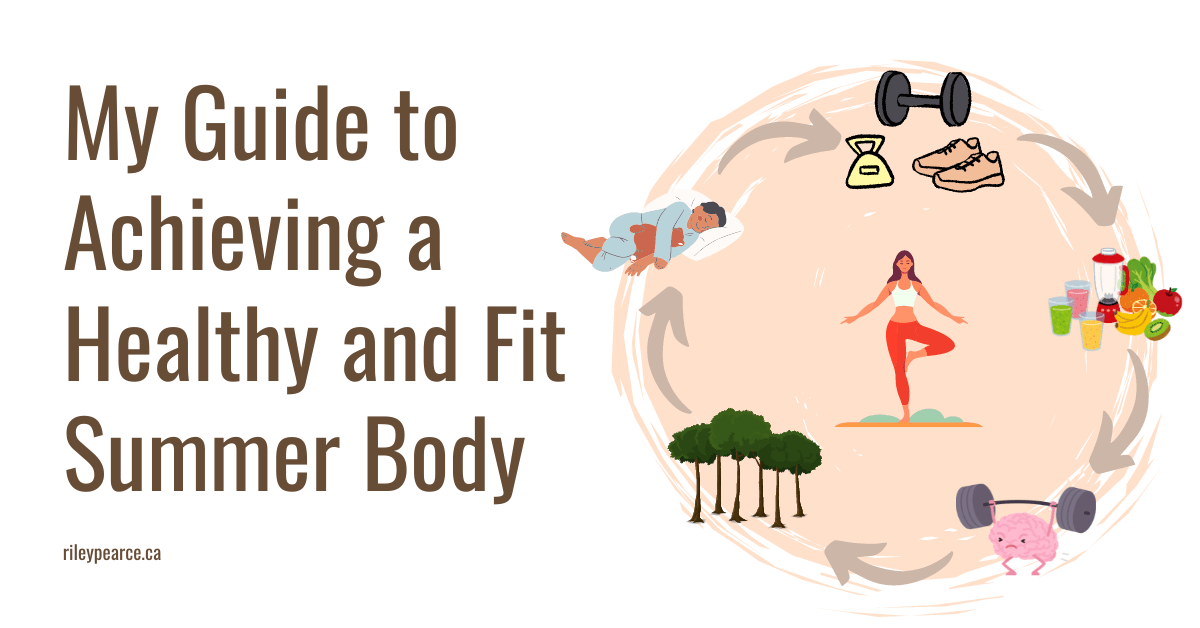
This guide will include 5 parts: exercise, nutrition, mindset, environment and sleep. It is these 5 components that make up the most complete guide, in my opinion, and by the end of this you will feel more equipped to get in great shape this summer, feeling confident, well-rested and excited to wake up and size the day. .
- Exercise
- 7 Principles of Exercise Training
- Training Principle 1: Individuality
- Training Principle 2: Specificity
- Training Principle 3: Progression
- Training Principle 4: Overload
- Training Principle 5: Adaptation
- Training Principle 6: Rest
- Training Principle 7: Reversibility
- Applying the 7 Principles to Your Summer Goals
- Nutrition
- Feel Whole with Whole Foods
- Understand your macros and micros
- Carbohydrates
- Fats
- Protein
- Micronutrients
- Manage Sugar Intake
- Mindset
- Self-Acceptance is Step 1
- Positive Mindset isn’t Everything, but It Is Important
- Having a Champion’s Can-Do Attitude
- Environment
- Sleep
- Sleep Cycles
- Setting Up for Sleep Success
Exercise
Our bodies are designed to move. This summer the whole world will have their attention on the Olympics, which is the ultimate showcase of all the ways our bodies can move. So if you want to be feeling your best, you need to find a way to consistently move your body on a regular basis.
Although I am a weight-lifting and long-walks girl, I will never tell you that one type of exercise the right or best type of exercise. Our bodies are different, how much time we have available to workout is going to vary, and our access to different types of exercise are going to differ.
So instead, I want to focus on the exercise habits that will help you feel your best this summer and should prepare you for any summer activities you have planned.
7 Principles of Exercise Training
When I was in school studying to become a personal trainer, one of the key theories that we had to commit to memory was the 7 principles of exercise training. So I’d like to frame my guide on exercise using these principles because they can easily be adapted to all fitness levels, time constraints, and workout options (gym, cycling, walking, running, etc.).
Before I share the first principle, I want to let you know that you don’t have to be applying all 7 of these every time you go to exercise. You can choose one, combine some, or find a way to incorporate all of them into your exercise. The point is to keep these in mind as you decide what training modality will bring you the most joy and the results you’re looking for this summer.
Training Principle 1: Individuality
I’ve already alluded to this in the previous paragraphs, but individuality is the training principle that reminds us that we have to find the exercise format that works for us as individuals.
As I mentioned before, I love weight-lifting and I feel my best when I am on a good weight-lifting program. But friends of mine prefer to mix up their weekly workouts with spinning classes, running and HIIT training. One of my sisters runs, walks, and swims. Another sister walks and rows.
Every person is going to have a type of training that suits them best and the key is to find whatever you are willing to do consistently. Because if you are only able to do the 2hr weightlifting session once and then hate the idea of doing it again, that’s not going to get your anywhere.
So think about all of the different forms of movement you’ve done in your life. This includes walking, swimming, running, weight-lifting, playing sports, and taking workout classes. Try to think about which one you enjoyed doing the most and would like to do again. Maybe you like a few different types of training options! In that case, variety may be the secret spice to your exercise life.
Training Principle 2: Specificity
The second principle is most relevant to people who have very specific goals. If your goal is to move more or exercise 4x per week, that’s great. You don’t necessarily need to drill down further into the specifics of your training plan, you just need to make sure you’re moving more than you were before, or getting to the gym 4x a week.
Specificity is a training principle that more-so applies to you if you have a very specific goal. For example, I’ve decided that I’d like to get my running performance back to my high school performance. Specifically, when we had to run a 4K and I was able to do it in 20 minutes and 19 seconds.
In my situation, my goal is very specific, so I need to make sure how I exercise is also well thought out and specific. I’ll continue weight-training, but I also need to make sure I am running often and training my body to run at the pace I’d need to run to complete a 4K in 20 minutes, but also train my body for endurance, as running for that amount of time will require more stamina.
When we look at the Olympic athletes this summer, each of them have been following very specific training plans that will improve their performance in their sport. Their coaches will break down every movement and skill in the sport and make sure they spend time training each of those movements.
Their coaches will also think about what muscles need to be strong, and which joints need to be supported by good mobility and stability to protect their athletes from injury.
When you are an olympian, training specificity is crucial, and I personally love to take this athlete mindset into my training. Thinking about all the specific exercises I could do to help me get closer to my goals makes training more interesting as it invites a lot of play, experimenting and creativity.
Training Principle 3: Progression
If you’ve ever followed a workout program or tried sticking to a certain exercise format for any extended period of time, then you’ve likely had a training plateau. This plateau happens after a few weeks or months of seeing steady progress, and then all of a sudden, you stop seeing progress and you plateau.
This is very common, and in advanced training programs, the plateau is taken into account and actually worked into the programs. But for the every day gal like us, a plateau can be really discouraging and can throw off all of the positive momentum we had before.
This is why progression is crucial. Let’s say you started walking more this summer as your form of exercise. As soon as it starts to get easy, you’ll want to progress your walking program, either by intensity (walking faster, or changing your route to include more hills), time/distance, or frequency (from 1 walk per day, to adding a second walk every other day).
Other examples include going to the more intense version of your class, adding in more classes per week, increasing the weights or reps you complete per set during your weightlifting. Find a way to change your current routine in 1 small way (intensity, time/distance, or frequency) and you should be able to avoid the plateau, or get yourself out of one.
Training Principle 4: Overload
This fourth principle works together with the previous principle. As you advance your skills you always to continue to challenge the body. Overload it with a higher intensity that maybe feels almost too heavy, or too long of a run. By pushing your body and giving it a new physical test every now and then, you’ll continue to see results from your exercise efforts.
Training Principle 5: Adaptation
Adaptation is a really interesting principle and can be incredibly motivating as well. Our bodies are designed to adapt. We adapt to environments, exercise, changes in our diet, and the stresses put on us as our lives change.
As you’re thinking about what training modality is right for you this summer, definitely find what you love, but don’t shy away from something you haven’t tried yet or want to try again despite it feeling potentially too challenging for you. Although it is likely to be difficult, and therefore more challenging to motivate yourself to get up and do it every day, trust that your body will adapt and it will get easier.
As an example – after the pandemic when I had been away from a proper barbell and weights for over a year, I got back into the gym and was feeling really anxious about rebuilding my body and reconnecting with my love for the gym. I can remember doing a simple core exercise that I used to do in the past, but feeling so weak and awkward.
However, I thought about it and reminded myself that that day would be the hardest that exercise would ever feel. Because our body’s adapt. So even though doing that core exercise felt discouraging on day 1, the next time I do it, it will be a little bit easier, and the following workout will be even easier.
So whatever your training modality is this summer, if you find that it is really hard one day, just remind yourself that our bodies are built to adapt, and the next time will be easier.
Training Principle 6: Rest
If you have read any of my other blogs, you know that I am such a stickler for rest. Whether is it resting between sets, how you rest between workouts, or figuring out your active rest, I LOVE rest and think it is such a powerful training principle. I even put together a list of rest day essentials here.
On a really high level, we know that rest is important for all of us because just about every living thing has a period of rest in their day. Humans need sleep, sharks and dolphins find a way to sleep, and bears spend months in a deep resting state. So clearly, if we want to benefit from training principles 1-5, we need to make sure you prioritize rest as well.
If the sleep argument isn’t enough to convince you, then think about how burn-out has become so prevalent in society today. We are being asked to be so productive and to always be “on” and delivering at work, completely negating our need for periods of rest. Our brain needs a break or a more balanced approach to work, and when we don’t get that, we burn out.
The same is true with training. If you are going 100% all the time, no days off, constantly progressing and overloading your workouts, you are going to over-work the body and it will resist. Resting gives your body time to recover, adapt, and prepare for the next workout. If you never give it that time, then it will take you a lot longer to achieve your goals.
So please, make sure to work in rest into your summer plans. And again, if you’d like to learn more about why rest is so important and how to plan for rest, check out the linked article.
Training Principle 7: Reversibility
This training principle can be taken in a similar way to the glass half full or half empty argument. In one sense, reversibility means that if you stop training, your body will revert back to the body and fitness level you had before, since that is easier for your body to maintain.
But on the flip side, if you take time off from training, your body is also going to be able to get back to your previous fitness level faster. So if it took you 3 months to run a 5K in under 30 minutes the last time you had a consistent schedule, then this time it might only take you 2 months because there is that deeply coded memory.
Going back to my post-pandemic workout story where I was worried about feeling weak on that first workout – I also knew that as long as I stuck to my training program, I could get back to my lifting PRs a lot faster than it took me the first time I hit them.
So if you have a couple off days or even a few off weeks where you aren’t consistent, hopefully this gives you some peace of mind and motivation to get back on the horse and try again because your body is ready to move and to return you to a previous fitness level.
Applying the 7 Principles to Your Summer Goals
As I mentioned before, you can combine all of these or focus on a 1 or a few. Knowing about them and having them as a resource in your back pocket is really empowering because it can act as a framework to guide all of your future exercise goals.
I’ve said it already, but consistency is truly the key here. All of these training principles rely on consistency, so as long as you are moving your body on a consistent basis, feeding it beautiful food on a consistent basis, and getting consistently good sleep, you’ll be amazed at how quickly you start to feel more energetic and confident in your body and what you’re capable of.
Nutrition
Understanding how nutrition plays into how you feel is a truly empowering and time-saving skill. I was thinking about this the other day when I was researching new skincare for myself and feeling a little frustrated that I really don’t know for sure what works and what doesn’t work for me.
It takes years of trial and error and breakouts and allergic reactions before people figure out what truly works for their skin. The same is true with nutrition. Eating is a basic survival skill and we’ve been consuming energy since the dawn of time.
Yet in today’s world, we’ve mixed the messages up and have been fed so many conflicting theories about what is good and what is bad that it can feel impossible to navigate and feel confident that what you are eating is actually going to support a healthy body and mind.
I am grateful that conversations around food have always been a part of my life and that I also have taken many nutrition courses and have received sport nutrition coaching in my life. It takes out a lot of the guess-work and I can confidently say that I know exactly what I need to eat in order to achieve my goals.
The purpose of this guide is to help equip you with the tips, tools and resources to feel your best this summer, so the following pieces of advice are exactly how I would advise my friends and family if they were looking to improve their overall health and wellbeing through food.
Before I list them, I want to mention that these are not prescriptions or medical advice. If you have specific dietary considerations and limitations, speaking with a registered dietition is the best way to get answer and to address your specific needs. The following advice is a blend of anecdotal evidence and knowledge sharing from my 2 years of nutrition courses and over 10 years of sports nutrition coaching.
Feel Whole with Whole Foods
If you want to feel whole, whole foods are the secret that seems too simple to be true. What I mean by feeling “whole” is feeling like your body has everything it needs to get through the day with a sharp mind and an active body.
If you’ve ever woken up feeling well rested and ready to get out of bed without too much struggle, then gotten on with your day feeling like you had the energy to exercise, think clearly and problem solve at work, and socialize with friends, all before going to bed feeling ready to fall asleep without any issues – this is the whole feeling we are after with whole foods.
The reason whole foods are always my first piece of advice when someone is looking to feel their best is because our bodies evolved on whole foods. Whether your ancestors were hunter gatherers or foragers, our species survives today because our ancestors were eating whole food diets.
So if you want to make it as easy as possible for your body to metabolize your food and provide you with the right energy for exercise, problem solving and socializing, then give it the raw materials that it has had thousands of years to recognize and learn how to break down in the body.
Whole foods, in most cases, have not been chemically changed or enhanced to disrupt what nutrients are available and how those nutrients are used in the body. Having a blueberry over a store-bought blueberry muffin or a blueberry nutrigrain bar is going to give you all of the benefits of blueberries, whereas the other options will have had some of the nutrient complexity of the blueberries lost in the manufacturing process.
If it doesn’t require taking it out of a box, bottle or a bag, you’ve got a whole food. This excludes things like bagged potatoes, peppers and lettuce. However you can also buy all of these outside of a bag, in which case I would recommend choosing those over the bagged options.
The only other exception I would highlight here is if you are vegan and are looking for protein alternatives. Things like tofu, falafel, beans, lentils and other vegan protein alternatives are typically in some form of packaging.
If you start with a whole foods mindset, you’ll be in a great position to feel your best this summer. They typically take some time to prepare, including cutting, cleaning and cooking, but with ample planning you can work this into your weekly routine so that you have healthy whole foods ready for you to eat during the busier times of the week.
Understand your macros and micros
Understanding your macros and micros (macronutrients and micronutrients) is really important, but I am not going to give you a full on biochemistry lesson today. Instead I’ll give you the basics that will help you make food choices that align with your health goals, but also have been shown to support a healthy body and mind.
Carbohydrates
Carbohydrates are often villainized as a whole macronutrient group, when really there’s only certain types of carbohydrates that I would consume in lower quantities than other carbohydrates.
Carbs are an important macronutrient because they provide us with quick energy. Not only that, but some forms of carbs also provide us with fiber, which is an essential nutrient that supports a healthy gut microbiome. And on top of that, many carbohydrates are also full of beautiful micronutrients and antioxidants that keep all of those behind-the-scenes processes operating smoothly. This includes things like our immune system, muscle recovery, brain function, hormone production, metabolism, hair growth, skin health, etc. etc.
The carbohydrates that I focus on and always make sure my friends and family are eating are fruits, nuts and vegetables. If you are eating a variety of fruits, nuts and vegetables, you can feel confident that you are getting ample fiber in your diet, that you’re likely maxing out your micronutrient recommendations, and that you’ll have good clean energy to do everything you want in a day.
Grains are still an important part of the diet, but I personally recommend having these in much smaller quantities than your fruits and vegetables. This is because many of the grains that we consume simply have to be processed before we can eat them. Breads, flours, pastas, and crackers all need to be processed in order for us to eat them and because there is that extra step before it gets on the shelves, we’ve exposed our food to manufacturing processes and big food companies do a lot to produce food cheaply, and to make it last on the shelf.
With that, if you want to make a yummy tortellini soup, go for it! Having pasta or a piece of toast won’t completely ruin your pursuit of a happy, healthy body, just remember to pair it with fruits, vegetables, healthy fats and proteins.
Fats
I think fats have gotten a really bad reputation lately and I don’t think that’s fair. Especially as someone with a nordic background, whose ancestors needed all of those calories to survive the long winters!
Fats are not only high in calories, but they are also foods that offer a high volume of vitamins and minerals, and typically those vitamins are fat-soluble as well – meaning they need the presence of fat in order to be absorbed by the body.
I’ve written a whole article on why fat is so important for human health, so go check that out if you want the full deep-dive into the importance of fat in our diets.
Examples of healthy fats include certain types of meat, like fish, pork and certain cuts of beef. You can also get fats in nuts, seeds and some fruits, like avocados and olives.
Dairy can also be a good source of fat as well, and as long as it hasn’t been overly processed with sweeteners, you also get the benefit of proteins and probiotics in dairy products. I also recognize that this goes against my no bag, bottle, or box advice before, but this is a great example of knowing what versions of those products are good for you and your healthy body goals.
Fats are full of calories, so the other nice thing about these, especially during a cost of living crisis, is that you don’t have to eat as much of them to get the energy benefits. Fats have 9 Calories per gram, while carbs and proteins have 4 Calories per gram, so you’re getting more than twice as many Calories with fats as you would with carbs or protein.
As you’re planning your grocery list, you now know you want to prioritize whole-food carbs, loading up on fruits and vegetables, followed by your healthy fats, and then, if you haven’t already, you’ll start choosing your proteins.
Protein
Being that this is a health and fitness website, I am of course going to talk about protein. Protein is probably one the only macronutrient that hasn’t gotten as much hate or criticism. Their are low-carb diets, and low-fat diets, but you rarely hear about low-protein diets.
This is with good reason – protein is absolutely crucial to their health or our bodies down to the cellular level. Proteins are made up of amino acids. When we consume protein, our body breaks it down into those amino acids, and those are used to help build our cells.
Because protein is so important, there is a lot more information our there about proteins. All animal products will include some protein, with red meat having a high amount of protein per gram of meat, and dairy products having a lower quantity.
Most products with fats like nuts and seeds will also be healthy sources of protein, but some grains can also provide protein as well, such as quinoa, lentils and beans.
Proteins can also be the most expensive items on your grocery list, so if you want to make sure you are getting enough protein in your diet, try to plan for protein at every meal, for a maximum of 1g of protein for 1kg of body weight.
This looks like 2 eggs at breakfast, yogurt with fruit and nuts at lunch, and a a chicken breast or filet of salmon at dinner. I am not recommending this is ALL you eat, but know that if those are present throughout your full day of eating, you will likely be eating sufficient protein for your health goals.
You can listen to a really great podcast from Science VS. on the topic of protein here. I found that episode did a great job of explaining where all of the previous recommendations came from, but also shows how easy it is to get enough protein in your diet. As someone who has research protein my whole life, and who worked as a personal trainer and was sucked into the extreme side of protein consumption, I was so happy to hear this podcast explain why protein is important, but to also simplify protein consumption.
Micronutrients
Now that you know about your macro nutrients, which you should be consuming in high quantities, it is time to (briefly) get into micronutrients.
As the name suggests, these are the nutrients you need to get in smaller quantities. They are the epitome of the the idiom “sum of its parts” because each micronutrient has a part to play, and when you body has enough of each of them, your body can feel it’s best.
Some common micronutrients you will be familiar with include salt, vitamin D, vitamin C, electrolytes (technically these are a group of salts), potassium, and calcium.
Micronutrients are vitamins and minerals and are found naturally in all of our whole foods. So if you are following the first tip about focusing on whole foods, you’re likely getting all of your micronutrients in sufficient quantities.
One of the few exceptions here is vitamin D, which our bodies produce naturally when exposed to sunlight. For us folks in regions of the world that do not get 12 hours of sunlight every day of the year, supplementing with high-quality vitamin D is important to maintaining a healthy mind and body during the winter months. Although you can get it in small quantities from eating small fish like anchovies.
In your pursuit of a healthy body and mind this summer, I wouldn’t spend too much time focusing on micronutrients. As long as you are eating your whole foods and eating a variety of whole foods, you are likely getting all of the micronutrients you need. I wanted to make sure I mentioned them so that if you want to do your own research into micronutrients you can. Just be careful because there’s a lot of nonsense out there that is just trying to sell you a supplement.
Manage Sugar Intake
For the final piece of nutrition advice, I really want to make sure I mention how to manage sugar intake and why this is so important. This is also coming from a self-proclaimed sugar addict, so I’ve felt the worst of it, done the research and have also felt what it feels like when I am managing my sugar intake.
Sugar as a food molecule is not inherently bad. All carbohydrates have sugar in them, the type of sugar is what varies and what makes the difference.
I’ve mentioned before that I base a lot of my nutrition guidance on my understanding of how the human body evolved and what type of food it evolved on. As our ancestors were hunting, gathering and foraging, they would come across fruits and vegetables and these would provide them with sugar. That sugar, in its many complex forms, would provide us with quick energy and would signal to our brain to keep gathering and foraging, providing us with consistent food sources and the energy to survive.
In today’s world, food manufacturing companies have taken advantage of the fact that when our brains have sugar, we will continue to seek our more food. In the past sugar wasn’t always easy to find, so we didn’t run the risk of having too much of it. Today, you can find highly processed, simply sugars in just about every shop and store you enter.
This is really worrisome for us because that system in our brain to reward us for finding sugar and then making us crave it again to encourage more foraging, now exists in a world where we have constant access to sugar.
And the sugar that is sold to us the most is highly processed sugar, which has been designed to be ultra addictive.
Now, I want to mention that I will never tell you to cut something out of your diet completely. There’s a lot of research on how when you cut things out, the result is lower mental health scores. I don’t want to create that stress, but I do want to help you find a more mindful balance when it comes to sweets. I don’t want to have to turn down my aunt’s fresh-baked chocolate chip cookies, and neither should you!
As with all things, moderation is key here. Know that you will naturally consume sugars in your diet when you are eating fruits, vegetables and some diary products. The issue lies in having too much processed sugar. So going out and having a whole bag of fuzzy peaches every day is going to impact your health long-term. But if you treat yourself to a few fuzzy peaches from that bag every other day, you’ll actually be okay.
When I felt my absolute best and healthiest, including having a really clear mind and tons of energy throughout the day, I was treating myself to something sweet once a week. I know that I like it and I’ll go crazy if I don’t, so giving myself that treat and making it a real reward after a week of hard work and great workouts felt amazing and re-aligned me with that reward system that helped keep my ancestors alive.
So to wrap this up – sugars in whole foods are great and should not be feared. Processed sugars should be consumed in moderation and limited to avoid promoting an unhealthy gut, brain and cardiovascular system.
To wrap up the nutrition section, it is important to remember that every body is different. So, in a similar fashion to my skincare story, there will be some time required to try things out and see how they make you feel. However, if you think about eating whole foods, getting a healthy variety of your macronutrients, and managing your sugar intake, you’ll have a great framework to start building out the perfect diet for you that helps you achieve your goals.
And finally, if any of your goals are based on losing weight, I want to leave you with one final thought that has really helped me stress less about food. In the past I was always trying to see how little food I needed to survive and then let that be the thing that makes me lose weight.
But after studying nutrition in school, I realized that what I really needed to be doing was finding out how much food I can eat while still achieving my goals. Because as soon as you get your body used to eating next to nothing, the moment you eat more than nothing, your body will want to hold onto that. But if you can achieve your health and fitness goals with a full day of eating beautiful food, you are less susceptible to your body freaking out every time you eat a little more or a little less one day.
Food can be a really touchy subject and is linked to many mental health issues a well, so if you are struggling with your diet please consult a registered professional who can offer you the proper guidance and resources (US & CA).
Mindset
Understanding how mindset can impact your health journey can be the difference between something being a fad diet and something becoming a lifestyle. Our minds are so powerful and quite literally guide all of our decisions through every moment of every day of our lives.
As I continue this guide to achieving a healthy and fit summer body, I am excited to share how I have harnessed the power of a strong mindset to help me achieve my health and fitness goals. By combining self-acceptance, a positive mindset, and a can-do attitude, you’ll also be training the mind to make better decisions that will lead you to your goals.
Self-Acceptance is Step 1
I am really passionate about the body positivity movement and changing the conversation from only accepting a certain body type, to rewiring our brains to accept and love our bodies as they are.
I wrote an entire article on the body positivity movement and why I think it is so important for the fitness industry, but the spark-notes version of it is that if you do not love and accept your body today, then you will find it difficult to love it at any point. And if you do not love and accept it today, why would you bother giving it the care and attention it craves to improve your overall health metrics.
I think about it this way: have you ever had someone in your life that you loved so dearly and would do anything and everything for to make sure they were happy and they knew you loved them? Now think about someone who you did not love, someone who you judged or spoke negatively about (we all do it, don’t worry).
The mindset and how you treat both of those people are patterns of behaviour. So your brain knows to treat people and things that you love with time, attention, and care. If someone or something doesn’t bring you joy and you don’t love it, chances are you’ll be more inclined to neglect it.
This is why learning to love and accept your body as it is the first step to wanting to change your habits and get in the best shape of your life. Because if you can say that you love your body and you accept it for the capable vessel for life that it is, then you will be more inclined to actually take the necessary steps to take care of your body.
So make sure that as you begin, restart or continue your health journey, that you always take time to let your body and mind know that you love and accept it as it is today and because you love it, you’re going to make sure you take the best care of it.
Positive Mindset isn’t Everything, but It Is Important
Once you’ve learned to love and accept your body as it is today to create a mindset where you want to take care of your body, it is time to get your mindset thinking positively about the experience as a whole.
I am not talking about toxic positivity where absolutely everything is perfect and nothing could ever go wrong. No, you need to be able to see where mistakes are made in order to learn from them. Instead, you can benefit from adding more moments of positivity into your journey.
I like to think of these moments of positivity as celebrating my “little wins”. The concept of little wins is something I have been practicing my whole life. Sometimes you have really big goals, and you can see how it will take a whole soccer season to become the top goal scorer or be considered for MVP. So along the way, you think about all of the little wins that keep your motivation up and remind you that there is an even bigger “win” at the end of all this.
This keeps the whole process more fun, and like I mentioned, gives you little milestones along the way that keep your motivation to succeed up. Every time you celebrate a little win, you also get a little shot of dopamine, which is critical for habit formation and maintaining your motivation. And if you don’t know already, habits are what you need when motivation doesn’t show up.
So as you are showing up to your fitness classes, or getting up for the 10th straight day in a row for your morning run, remember to take a moment to celebrate that little win.
Having a Champion’s Can-Do Attitude
This final tip is inspired by all of the sports documentaries I have been hyper-fixated on this summer. Specifically if you watch the Break Point series on Netflix or the Nadal vs. Alcaraz special on Netflix, you see that having a champion’s mindset is what separates the greats (Nadal, Federer, Djokovic) from the new up and comers is how they are able to maintain a steady, winning mindset.
Something I’ve noticed specifically is that they never count themselves out. An interview will ask a leading question or make mention of some kind of perceived advantage their opponent has, and all of the greats are able to respond in a way that communicates that they always believe they can win.
I believe this mindset can be applied to every-day health goals. It essentially trains you out of finding excuses or ever believing you can’t do something for some reason, and trains your brain to believe that no matter you can and you will always find a way.
As an example, I have gotten into the habit of believe that I can’t run because I have legitimate knee and hip issues and bad running shoes. But since watching these documentaries, I have adopted this new “can-do” mindset where now I am trying to find my work around. Yes, my knees and hips typically hurt after I run and if they hurt too much, it impacts my ability to live the rest of my life. So why not break my running goals into smaller bites.
I know I could run a 5K if I really wanted to, but if I want to achieve a running goal and enjoy running without pain, then why not make it really easy and just set out to run 2K. I can run, I just have to modify my running plan so that my knees and hips aren’t over worked and risk injury.
It’s really all about having a deep sense of belief in yourself, and being a problem solver. If you can master this champion’s mindset, I am confident that you’ll find yourself thoroughly enjoying your health journey and discovering a new sense of self-confidence.
Being as intentional as possible about developing a strong mindset around your health and fitness goals is going to be such a game-changer for you this summer. Remember it starts with self-acceptance, you’ll enjoy the journey with little-wins, and you’ll cross that finish line with a champion’s mindest.
Environment
A healthy environment is often neglected when we are pursuing a our health and fitness goals but it can make a huge difference. As I am writing this I have just spent 5 days out in the country enjoying fresh air, sunlight, and general peace and quiet. My skin has cleared up, my mind feels refreshed and at peace, and my body is feeling ready to get back to more high intensity training.
Having the right environment is an important piece of the puzzle towards success. Now, I know that not everyone has access to the wide open world of the countryside, but we can create moments of peace and a positive environment that will help support a healthy mindset and support a healthy body, inside and out.
For example, I live in the city in a noisy apartment. If I were to spend every moment in that apartment, my body would be completely out of whack. Our bodies need fresh air and connection to nature. So I make sure to keep my apartment organized so there isn’t a sense of chaos at home. Then I make sure to leave my apartment at least one a day for fresh air.
Fresh air can be taking the dog for a walk, walking to the gym, taking the long route to the grocery store, or even driving out to a hiking trail if you have access to a car or public transportation. Fresh air is one of the easiest ways to calm your nervous system and regain a sense of inner calm and peace.
When we allow our environment to be too out of touch with nature, to always be “on”, go-go-go, and chaotic, we put our nervous system into overdrive and, again, wind up burnt out, anxious and with no motivation left to do anything.
To build out a stable and supportive environment that will help you achieve your health and fitness goals, think about how you can reduce chaos and invite more peace into your life in the following areas:
- Home: keep your home tidy, organized, and well stocked with the foods that will support your health and fitness goals. Go back to the nutrition section of this article for a refresher on what supports a healthy lifestyle.
- Outdoors: if you live in a busy, concrete jungle, do some research and find a local park or a hiking trail that is accessible to you so that you can reconnect with nature on a regular basis. Life in the city is great and so exciting, but our bodies and brains really do need to be close to nature and flowing water to find a sense of peace.
- Social Settings: the final environment factor that could impact your health and fitness goals is your social setting. Are you friends supportive and positive? Do they encourage your “can-do” attitude? Do you go out to places that bring you joy and make you feel safe and happy?
Audit each of these environmental factors and see if they support your health and fitness goals. If they don’t now, see what small change you can make or suggest to improve that environment. Even small changes can make a big difference.
Sleep
It seems apt to close our the guide with my tips and advice on sleep. As I mentioned before, every living thing rests in some way. Sleep has to be crucial survival because everyone is doing it.
Understanding your sleep cycle, how you can build healthy sleep routines, and ultimately how your sleep will impact what you do during the day can make a world of difference.
Sleep Cycles
You may have heard of your circadian rhythm, which is a daily cycle of hormones driven by light and dark that controls our energy during the day and when we sleep and wake up. But did you know that during your sleep you also go through a set of sleep cycles?
When we sleep there are 4 stages, 3 non-rapid eye movement stages, and 1 rapid-eye movement stage. You may have heard of REM sleep before, which is the 1 rapid-eye movement stage of your sleep cycle. If you get good quality sleep, your body will go through 4-6 sleep cycles, lasting about 90 mins each, before waking up.
Of these 4 stages, stage 3 and 4 are the more restorative and with a sleep tracking app or a fitness watch, you can keep track of the quality of these sleep stages to get an idea of how restful your sleep is.
Stage 3 is your deep sleep. You are not dreaming during deep sleep but your body is very relaxed during this stage. Because the body is so relaxed, the brain is able to recover, rebuild and the more deep sleep you get, the more restored you will feel when you wake up. This stage can also be call the delta wave phase due to the delta waves that show up on brain scans during this stage of the sleep cycle.
Stage 4 is the famous REM sleep, or rapid-eye movement stage, which is when most people dream. This is also the time when your body goes into a phase of paralysis. With your body completely paralyzed, only your eyes and some face muscles are able to move and your brain can recover it’s most vital functions like memory, cognition and learning.
Why we dream is still a mystery, but there are some good theories that believe that we dream during the REM phase of sleep because we are recalling information we may have missed when we are awake and dreaming is our brain’s way of taking stock of memories and storing them. We can also dream to help us process complex emotions that we have not processed during the waking hours.
So why is all of this important to your healthy and fitness goals this summer?
Understanding that your body needs good sleep, and what good sleep looks like, will help you see why you may not be feeling physically ready for your workout one day. If you look at your sleep tracking app or fitness tracker data and see that you got less deep and REM sleep (stage 3 and 4), then you now know that your body wasn’t able to fully recover during sleep so you’re running on 50% battery instead of 90-100% battery.
Setting Up for Sleep Success
One of the best ways you can improve your changes of getting a good, restorative night of sleep is to create a good bedtime routine and sleep environment.
Falling asleep can be thought of as a habit, so if you follow the steps to creating a healthy habit, you can begin to fall asleep on a reliable schedule. And the routine that triggers your sleep habit can start as soon as you finish dinner.
For example, I have set-up my sleep routine to start with cleaning up my kitchen. I make sure the counters are cleaned, the dishes are done and it is ready for a new day. That then leads me to go brush my teeth, wash my face, and get into bed. I have smart lights that turn on at 8PM and are programmed to turn off at 9:30PM. So when I go to bed, I already have my soft, warm lighting ready to go for about an hour and a half of reading.
I then read until either my lights turn off or I get tired and turn off the lights on my own. Within a few minutes I am asleep and when my lights start to gradually brighten from 4:40AM – 5AM, I am feeling well rested and am woken up gently by the sunrise effect of my smart bulbs. The whole process is designed to support the best sleep possible.
Because I generally get a good night’s sleep, I am able to get to the gym regularly, I have the mental energy to be productive and effective at work, and I can make good decisions throughout the day. Each of these contributing in a positive way to my overall health.
So as you think about how you will incorporate better sleep into your healthy routine this summer, start by planning your bed-time routine. Once you have a set of actions that lead up to you falling asleep, and you’ve created a good environment for sleep, you’ll find you will feel more refreshed and energized during the day.
A few final notes about your sleep environment:
- The best temperature for sleep is around 15.6 – 20 degrees celsius (about 65 Fahrenheit). If you can have a fan in your room to keep it nice and cool and help you maintain a cooler body temperature, you’ll get a better sleep because your body temperature won’t rise during the night, disrupting those sleep cycles we discussed earlier. If you have the budget for it, there are some very advanced mattress cooling systems with the technology to manage the temperature of your bed at night.
- Your room should be as quiet as possible when you sleep. Noises in your sleep, especially as women who have evolved to hear our babies at night, can be easily woken up by any type of noise during our sleep. If you live in a busy apartment building or have roommates with different sleep schedules to you, then I recommend getting some kind of white noise machine. Sudden loud noises will wake you up, but if you have a consistent white noise or the sound of waves crashing, this can actually keep you asleep and muffle any outside noise. Alternatively you can use earplugs to block out noise while you sleep.
- Lastly your room should be as dark as possible. As I mentioned before, our bodies are programmed to wake up and fall asleep based on light signals in our environment. So if there any light in your room, this could disrupt your sleep. I recommend getting a good set of black-out blinds or curtains to block out the light from outside and making sure that if you have any tech in your room, that you can set it to night mode so there aren’t any blinking or glowing lights at night.
I may not know you personally, but I know that you are capable of achieving a healthy and fit summer body because I believe that the body is capable of so much more than we realize. By combining an exercise routine that suits your lifestyle, finding the foods that feed your goals and your soul, mastering mindset, creating an environment that supports your goals, and finishing every day with a powerful, restorative sleep, you will be able to not only have the summer body of your dreams, but you’ll also set yourself up for a lifetime of feeling healthy in both body and mind.














 Riley Pearce