
The other day, I was chatting with my sister about our exercise routines and other healthy habits, and I shared with her that, even at my most fit, I felt like I always had a lower belly “pooch”. My stomach would otherwise be flat, but there was always that little bump.
To which my sister said, “I think that’s just how our uterus sits in our bodies”.
This was quickly followed up by her questioning, “I wonder if you can train the muscle down there to pull everything in, like the drawstring on a pair of pants?”
The wheels immediately started turning in my head because I know that there is a very powerful, yet often under-trained muscle in that area that acts like a belt, holding the lower abdomen together and offering stability to the pelvis and lower back.
If the muscle exists, and the question has been asked, then the theory must be tested! In this blog, I am going to share the reasoning behind my theory that exercise alone can get rid of the belly pooch. Your uterus will still be there, but it’ll be tucked in behind the lower muscles of your abdomen.
The Anatomy of the Lower Belly
When looking at the anatomy of a woman’s lower abdomen, we can clearly see that the uterus sits at the base of the abdomen, just above the pubic area:

So already, my sister’s theory about our uterus protruding seems plausible. But what about our abs?
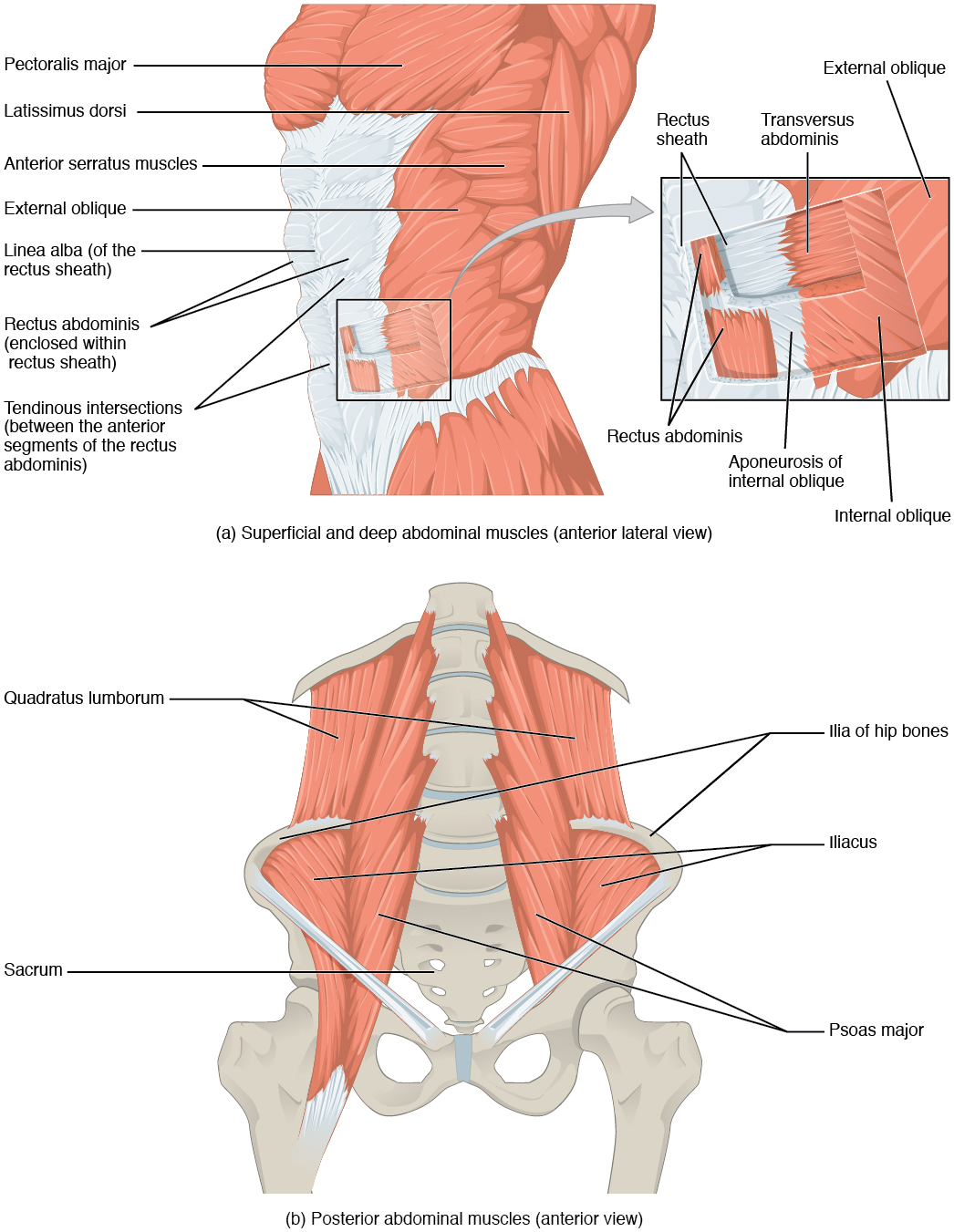
The system of muscles that make up the “abs” is designed to support and protect an area that houses several vital organs, including the stomach, liver, kidneys, pancreas, bladder, intestines, and, for women, our reproductive organs. The abdomen does not have the luxury of bones to protect these organs (like the brain, heart, and lungs), so our bodies have evolved to have a mesh-like structure of muscles that help keep our spine from collapsing on itself, and make us more resilient to sudden changes in direction.

The rectus abdominis, highlighted in yellow in the image above, is what most people see as the abs. The fibers of the rectus abdominis run vertically and allow our chest to bend forward, bringing our chest closer to our lower body, hence why crunches are such a classic exercise to develop these muscles.
The real hero and the muscle we’ll be focusing on to act as the drawstring, tightening up the lower abdomen area and getting rid of the belly pooch, is the transverse abdominis.
Spotlight on the Transverse Abdominis
I have always been a fan of this muscle because it doesn’t get the credit that the rectus abdominis gets, but it is actually working hard in the background and is the foundation of our core.
When people say to train your core, this is one of the muscles they are looking to target because the exercises go deeper than your visible abs.
It is called the transverse abdominis because instead of the muscle fibers running vertically, they run across the body horizontally. So when these muscles contract, the entire abdominal area becomes taught, the spine is secured, and you’ll feel more solid in your stance.
While you’re reading this, I want you to put your hands together like you’re going to clasp them, interlocking your fingers. Don’t clasp your hands just yet, but just loosely interlock your fingers. Now, bring your hands together, so your palms are touching and your fingers are now resting on top of the backs of the opposite hands.
When the hands were in a more open structure, this is your transverse abdominis (T.A.) at rest. There isn’t a ton of movement allowed, but you can still move your hands fairly easily. When you bring your hands together, that’s what a contracted T.A. is like. If you try to move your fingers or hands, you likely won’t be able to, and you’ll find that you can only move your upper arm.
This is a very important, powerful muscle, but because it is a deeper muscle to train and doesn’t have the same obvious, visual appeal as the rectus abdominis, it is often forgotten in training plans.
But have no fear, because our journey to discover if we exercise alone can get rid of the belly pooch continues!
How to Train Your Transverse Abdominis
You may have started to think about exercises you know that would train the T.A. But if you’re trying to get the muscle fibers to contract to replicate the interlocking hands example, the options may not seem immediately obvious.
Especially when most ab exercises that people are familiar with are things like crunches, twists, and leg lifts. Like many other exercises for other areas of the body, your abs are involved in the movement. But allow me the opportunity to teach you about the 3 types of muscle contractions, which will reveal how we can train our T.A.
Our muscles are capable of 3 types of contractions:
- Concentric Contraction: a shortening of the muscle. Think biceps in a bicep curl, rectus abdominis when you’re crunching, and your hamstrings when you do hamstring curls. The target muscle ends up bunched up at the peak of the exercise.
- Eccentric Contraction: A lengthening of the muscle. Think about how your biceps feel when you are lowering yourself down from a pull-up. Despite your bicep being lengthened and what feels like a stretch, it is still contracting to allow you to control your movement down.
- Isometric Contraction: a special type of contraction where the joints around the muscle do not move, but the muscles are still contracting, which in turn helps the joints around the muscle to not move. Think planks. You know your abs are contracting, but your hips and spine are not moving, and this is because your core is contracting, keeping everything “locked in”.
To train our transverse abdominis, you have to pick exercises that fall under the isometric contraction category. When done correctly, they are incredibly effective at strengthening this deep muscle and will be very useful on our quest to get rid of the lower belly pooch.
My Exercise Plan to Get Rid of the Belly Pooch
Okay, so now that you understand what muscles we are trying to target, and the types of exercises that work those muscles, it is time to outline my plan that will test my theory.
There are 2 exercises that are so tried-and-true when it comes to training the core muscles and can be modified to suit your training experience. The first is the plank. It’s a classic for a reason, so it will be the first of 3 exercises that I will incorporate into every workout over the next 4 weeks to see if the lower belly pooch becomes less pronounced.
The second exercise is the dead bug. I love this exercise and feel it is one of the best core exercises. You can modify the deadbug or use an exercise ball to help you maintain the correct technique.
And finally, I will throw in one exercise that technically trains the lower fibers of the rectus abdominis. This is to ensure I am working to tighten the muscles working in both directions. Transverse abdominis will tighten across the body, whereas the lower rectus abdominis will tighten from the pubic area up to the bottom of my ribs. So I will be tightening both vertically and horizontally.
The third exercise I’ve chosen is leg lifts. I like these because, again, they can be modified to suit your training level, and they can be made more challenging by adding weights. I can also do them lying down or from a captain’s chair. So if I ever get bored of the lying leg lifts, I can switch over to the captain’s chair, or add in a dumbbell to kick up the intensity of the exercise.
Final Thoughts on the Belly Pooch
I feel a sense of responsibility to make sure that I mention that there is nothing wrong with a lower belly pooch. It is so common amongst women, and I don’t want this article to make you overthink about that area, or to think that because I am working to “get rid” of it, that it is inherently wrong.
Our bodies are powerful, life-giving, and beautiful just as they are. In my case, I am curious about this theory because of a conversation I had with my sister and would love to be able to give her a definitive answer. Can exercise get rid of the lower belly pooch, or is it just something some women must live with and learn to embrace? I will know more in 4 weeks.
What are your thoughts on this? Have you ever tried to train a certain area of your body with success? Let me know in the comments!


 Riley Pearce