

Can cycle syncing help you achieve your goals faster and with more consistency? I have been hearing a lot about cycle syncing and have been thinking about it for these past few months as it relates to both what I eat and how I train.
But is there really any merit behind it or has the fitness industry just found another way to use a woman’s cycle to sell us more junk? In this blog, I am going to go through what cycle syncing is, if there’s any science behind it, and if I will be incorporating it into my routine more intentionally moving forward.
What is cycle syncing?
As a woman, we have been blessed with a magical, 28-32(ish) day cycle that gives us some serious highs but also some serious lows. The hormonal changes that we go through over the course of our menstrual cycle can vary in intensity from person to person, but the cycle remains the same:
- We begin our cycle with our menses, 3-5 days of bleeding due to the monthly uterine spring cleaning. When the body detects that we are not pregnant, it cleans up shop, and prepares the uterus for the next egg to be released. For women on hormonal birth control, your bleed is more of a withdrawal bleed, but you can still see this as the beginning of your cycle
- Next up is the follicular phase, when your body is preparing to release an egg, and thickening the walls of the uterus so a potentially fertilized egg has a cozy place to rest with all the nutrients it needs to grow. Your estrogen levels are increasing and so are your energy levels.
- Then it is time for ovulation. This is when the body is releasing the egg in hopes that it meets it’s match and you can pass on your DNA to the next generation. To help motivate you to find your egg a match, your testosterone levels are at their peak, increasing your sex drive, energy levels, and even your confidence and self-esteem.
- After the glorious 2-4 days, your body (pre-emptively) prepares you for pregnancy. The egg travels through the fallopian tubes towards the uterus, and your levels of progesterone increase. Believe it or not, progesterone is actually a calming hormone, though some women wouldn’t necessarily report feeling calm before their period. This is known as your luteal phase.
- When the body realizes that an egg has not implanted in the lining of the uterus, the cycle starts all over again.
I’ve somewhat simplified this process for the sake of highlighting how you feel, the dominant hormone for each phase, and how that impacts your energy levels. Every woman will experience a menstrual cycle that is unique to her, but the experience I will be working with for this article is “normal” one.
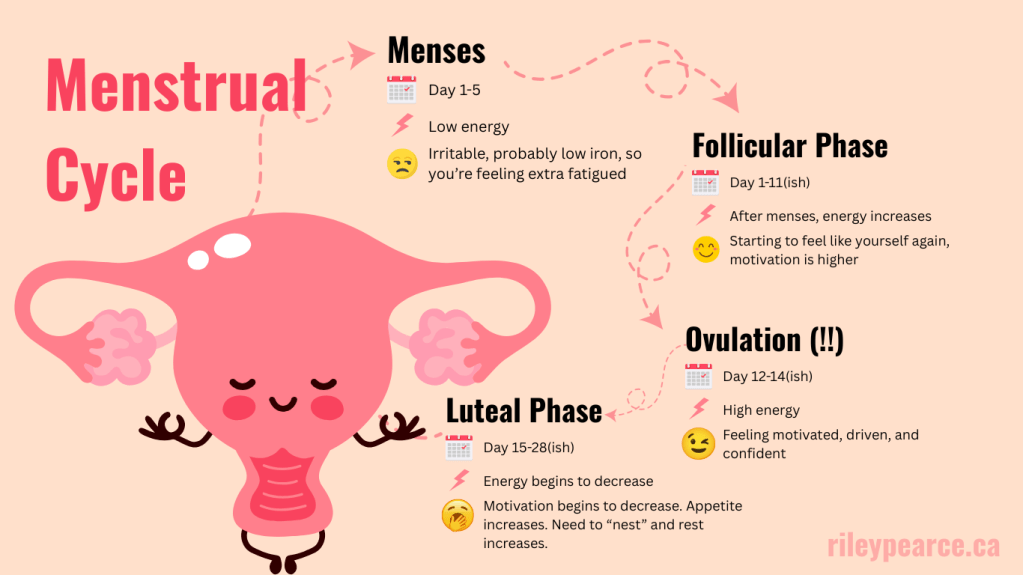
Now that you have the phases of the menstrual cycle fresh in your mind, let’s dig into what the theory is behind cycle syncing.
How to Sync Your Cycle to Your Workouts
To align your workouts with your menstrual cycle, you’ll want to think about the energy levels during each phase, and how your hormones in each phase impact your mindset.
Menses: Low and slow
During the week that your uterine lining is shedding and you are switching over from high progesterone to high estrogen, you’ll want to take things slowly. Don’t schedule your PR workouts during this week.
For my workout routine, which is strictly weight-lifting and light cardio, I try to schedule my deload weeks during this time. I’ll lower my weights and focus on form so that movements can be slower, and won’t require my full strength to get through each exercise.
Although it sometimes feels like fun to lift lighter weights, it is always good to check in on my lifting technique and really make sure I have a solid movement pattern. When I am having one of those types of periods where I just feel super depleated, I’ll typically do my core lift to make sure it gets done, and then I’ll head over to the treadmill for some easy walking, or take a very long time to stretch and work on mobility.
The goal is always consistency with any workout routine. So by respecting the fact that you’re going to feel tired and weak while you’re on your period, you take the pressure off and work more in line with how your body wants to move. No weeks missed at the gym!
Follicular Phase: Turn Up the Intensity
As your period nears the final days and you start to see the light again, you can also look forward to more motivation and energy that you can direct towards your workouts.
Lift heavy again, try some higher intensity cardio, maybe even add an extra day for abs and cardio for that week! Your body and your mind are both going to be craving challenges and newness during this week, so give it what it wants!
For my workout routine, I love the follicular phase. I feel more like myself and find I am able to focus on my lifts more. I start to rebuild that confidence to lift heavy and increase my weights at the gym. I may not be ready for some of my classic cardio finishers during this week, but if I have the energy at the end of my workout, then I typically go for it.
Ovulation: Push it!
During this time, take full advantage of the increased testosterone and confidence. You are feeling your best, you have a ton of energy, and that makes this the perfect week to try for a new PR or just go for a perfect week of workouts.
Week 3, as I see it in my programs, is always a fun week. It just feels so good to go into the gym feeling like there is nothing stopping you from having the best workout possible. If I match up my workout music with the energy that I have, then I will almost always do a high intensity cardio session at the end of my heavy weight lifting workout, simply because I feel so good that it would be silly not to!
I also find I am more inclined to do the hard ab exercises this week. Something about that extra bit of testosterone in my blood makes me want to do a hanging knee raise.
Don’t be afraid to push yourself this week. You’ve got the energy and the mindset to do it, so take full advantage.
Luteal Phase: Be mindful
Since the luteal phase is sort of the last “week” of your cycle, but is actually more like the last 10 days before the PMS kicks in, it is really important to listen to your body. You don’t necessarily need to pull back, but know that you won’t necessarily have the same energy for your workouts as you did during the previous phase.
In my weightlifting program, I use this “week” to try and continue progressing how much I am lifting in my core movements (squats, deadlifts, lat pull down, seated row, bench press), but if I don’t have the energy to increase the weight on the day, then I just try to repeat the weight I lifted the previous week.
Sometimes I get to the gym during this phase and the inner quiet and calm that I feel actually makes me really focused and I have a great workout. But sometimes I get in there and I am so tired that I just do my main lifts at last week’s weight, then hang out on the treadmill before doing some light stretching. This week is just about being mindful with your workouts.
Do whatever feels right for your body to get to the gym so that you maintain that habit. Even if it means going in a comfy, oversized sweater and your softest pair of leggings. Just get there so that you maintain the habit, but when you get there, do what feels right for the body.
How to Support Your Cycle with Your Diet
When it comes to cycle syncing with your food, I think it is actually more about supporting your cycle with your diet. What you eat impacts your energy levels, your mood, and ultimately delivers certain nutrients to the body. Those nutrients are sometimes needed in higher quantities due to the hormonal changes during each phase.
I won’t be giving you a meal plan by any means, but hopefully this next section gives you some direction as you plan your own meals and are thinking about supporting your body during the different phases of your cycle.
Menses: Low inflammatory foods, high nutrient density foods
I like to think of this period as own body’s way of cleansing us. Out with the old to make room for the new. So as part of that, it important to think about giving your body what it needs to start renewing and building.
Foods that are rich in nutrients are also typically rich in colour as well. So dark berries, red meat, dark leafy greens, and cruciferous vegetables like purple cauliflower and broccoli are also going to come packed with all of the vitamins and minerals that you need to support this time.
It is also important to recognize that you are bleeding for several days. All that blood loss means that women are at a higher risk of experiencing symptoms of low iron levels, which can leave us feeling faint and weak.
Again, darker leafy greens like kale and red meat naturally provide us with iron and although they are not always comforting like a piece of chocolate, you will ultimately feel better because of it.
Lastly thing to consider is foods that lead to inflammation. In some cases this can mean coffee as some women have a inflammation response to coffee, but in all cases it means avoiding highly processed foods.
Anything that would be foreign to our bodies – ie. things that don’t occur naturally in nature cause an inflammation response in the body. Because our uterine lining is shedding, we are already at higher levels of inflammation during this time. So don’t add insult to injury, and do your best to limit processed, highly sugary or salty, packaged foods.
Follicular Phase: Calorie Density is Key
During the late follicular phase, your body is preparing the egg and thickening the uterine lining. This takes a lot of energy and resources to do this. So as you plan your meals for this phase of your cycle, think about eating foods that offer a lot of energy, as well as a lot of nutritional value.
This is a great time to increase your carbohydrate intake since carbs are a great source of quick energy for the body to use. If you go for carbs with a higher fiber content, or pair your pasta with veggies and a lean protein, you’ll be feeling energized, well nourished, and ready to take on anything inside and outside of the gym.
The most calorie-dense foods are foods with a high fat content. Not only do they provide us with 9 kcals of energy for every gram of fat, but foods high in your omegas also provide the body with important building blocks to make hormones and prepare the uterus. Foods like avocados, nuts and seeds, eggs, and fatty fish like salmon are all great to eat during this time.
Ovulation: Simply Enjoy a Diverse Range of Foods
During the ovulation phase, the world is your oyster. You are feeling good, your energy is high, and you’re likely feeling more motivated to do the healthy grocery shop and cook that recipe you’ve been wanting to try.
So just have fun with food during this time. Remember your basics, and support your workouts with carbs and protein, while supporting your recovery with healthy fats, and high fibers fruits and vegetables. But beyond that, just enjoy these few days where fueling your body feels effortless.
Luteal Phase: Support Your Mood with Food
This doesn’t mean eating whatever you want because it makes you feel good. No, this is about being thoughtful about what you are eating, knowing that the food we eat impacts how we feel.
A few years ago when I was going through my post-birth control syndrome symptoms, I read a really great book called “The Female Brain” by Dr. Louann Brizendine, which taught me a lot about the link between the female brain and the food we eat.
Something that has always stuck with me from that book is the impact of sugar on our mental health. She shared that when women consume sugar, particularly processed sugar found in sweets and processed foods, it impacts our serotonin and dopamine levels, leading to feelings of anxiety and depression.
I don’t want to pretend like I don’t indulge in a sweet treat during my luteal phase, but I am always considering the fact that making a decision to have a quick hit of dopamine to comfort my changing mood during my luteal phase, is only going to lead to more discomfort later. Foods high in omega-3’s and your B-vitamins are also really helpful at this time as both support a healthy mood balance.
Things like salmon, almonds, chia seeds, eggs, and (again) avocados are all great ways to get a good amount of omega-3s and B-vitamins during this time.
As you get closer to the first day of your period, start thinking about the foods that support that phase of your cycle and start reintroducing them into your diet to prepare for it.
Does the science support cycle syncing?
Everything I’ve just said may sound good, and it may make sense, but does the science support cycle syncing as a viable training method? Kinda…?
One that is very important, and somewhat frustrating, is that there is very limited research on women’s menstrual cycles as it relates to exercise. So when I was doing my research to see if anyone had tested cycle syncing as a way to improve women’s workout results, a few things came up that were sort of related but not really what I was looking for:
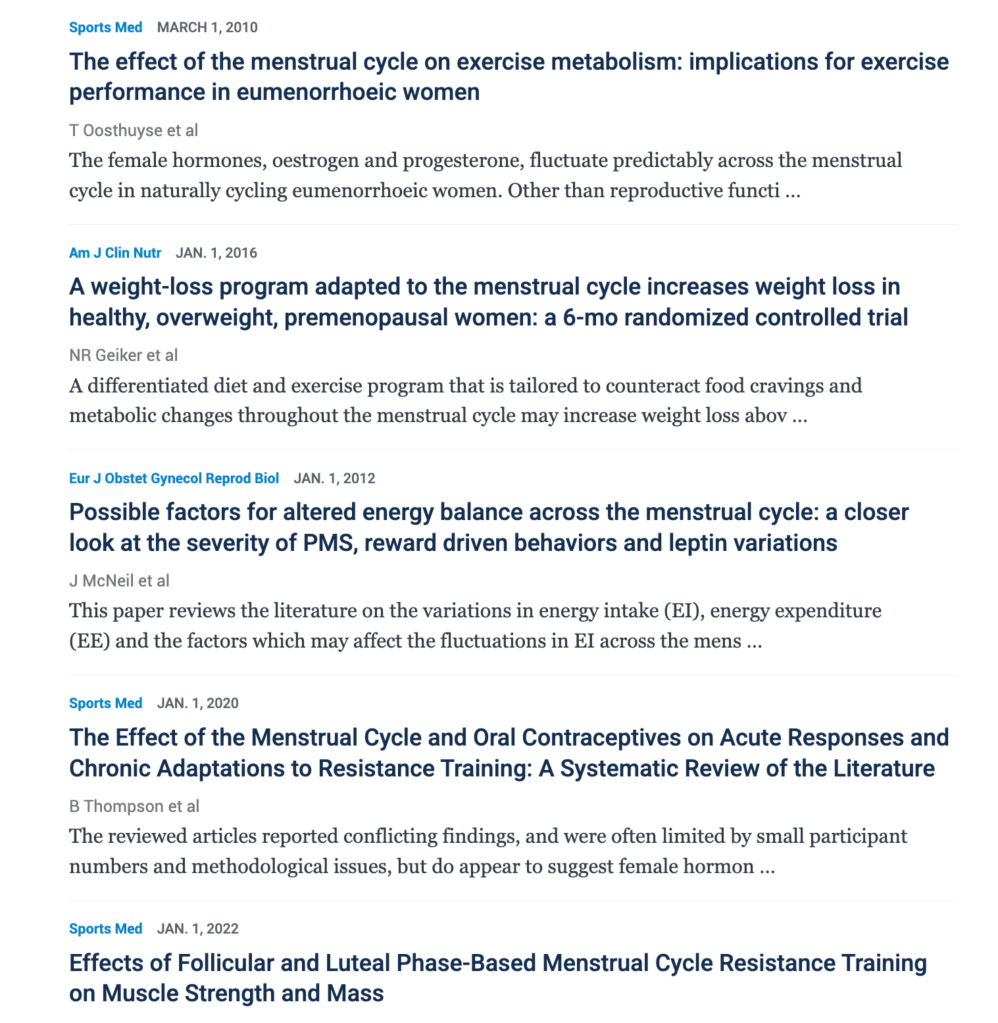
Even the report at the end there – from 2022 I might add – starts off by saying “There is an increasing interest in female athletic performance”. Now there’s an interest in female athletic performance?
This little rant is just to say that even though there isn’t a lot of scientific evidence to support cycle syncing, there is an increasing amount of anecdotal evidence to support cycle syncing. Women are actually following this protocol and are reporting great results, and we shouldn’t take that for granted just because the scientific community hasn’t caught up yet.
Will I be More Intentional About Cycle Syncing?
I’m so glad you asked! Truthfully, I have already been dipping my toes into the world of cycle syncing and, if I remembered, I was really trying to align my diet to better support my cycle. But even then, I’ve been experiencing some anxiety around grocery shopping and meal planning lately, which I talked about in my latest workout diary update, so it hasn’t been a 100% commitment from me on the whole cycle syncing thing.
With that said, after doing the research for this article and reminding myself how important food is for our mental health, and how listening to our bodies and adjusting our workouts accordingly can actually accelerate results, I am really feeling good about this protocol.
In fact I am going into my late luteal phase and will be in the dreaded menses phases shortly, so if I need to be intentional with my workouts and what I am eating, it is definitely now.
What do you think? Are you sold on cycle syncing or do you want to do more research for yourself? Have you already been cycle syncing? If so, how are you finding it? Let me know in the comments below. I love hearing your stories and experiences.
 Riley Pearce
3 thoughts on “What is Cycle Syncing?”