
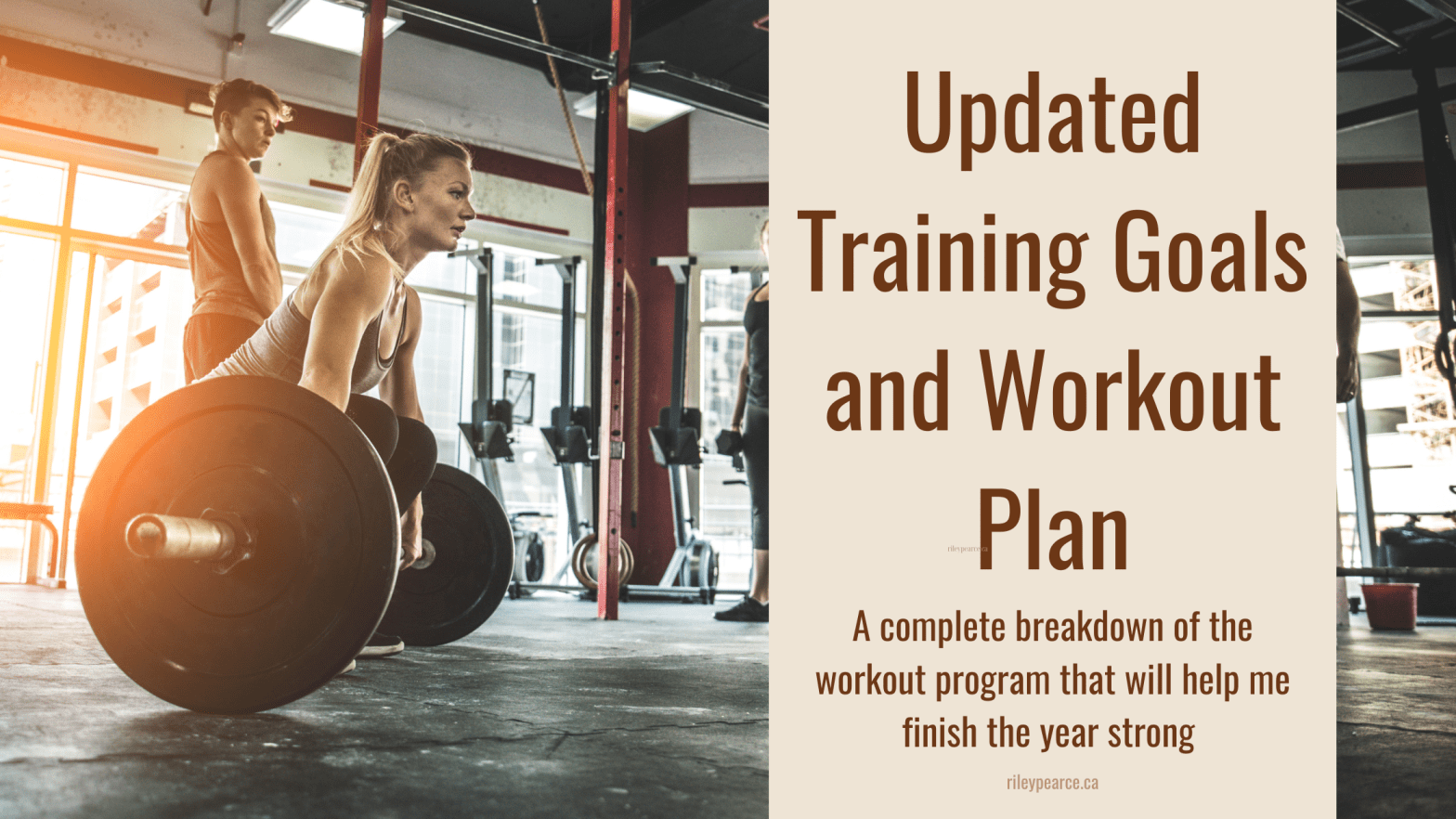
We are less than 3 months from a new year and I am feeling really motivated to achieve new goals in the gym. If you’ve been following the blog, you know I am on a glow up journey; just trying to do more everyday that makes me feel confident and successful everyday. So my goals and training plan have been updated for the final 3 months of the year and I am excited to share them with you.
The over-arching goal for the plan is to increase strength. If you’ve haven’t read my articles on why rest matters and why your reps and sets matter, go check them out as they’ll help give the “why” behind a lot of the training decisions I am making for this phase of my training.
As I said, I want to increase strength. More specifically, I am looking to hit my old PRs from when I was a full-time trainer. This means I would like to bench press 135lbs (1 plate), deadlift 215lbs (2 plates), do 10 chin ups, and then for my squat I have a non-strength-related goal.
Squatting is my weakest lift in terms of technique. Due to the way my femur (big thigh bone) sits in my pelvis, I find it difficult and sometimes painful to get into a deep squat.
However, I don’t want that to limit what I do in the gym. Squatting is an essential movement in daily life, and technically it is an important one to master given the benefits it provides in other areas of the body like the core, ankles and knees.
So for squats, I am going to work on strengthening each component of the squat to prepare myself for a proper, barbell squat routine in the new year.
This means strengthening my quads and hamstrings, improving my ankle and hip mobility, and improving my core strength. I’ll also (of course) be squatting to make sure I am working on building up that movement pattern, but starting with a very low weight to make sure I perfect the technique before lifting heavy.
Here’s a full breakdown of the program I’ll be following. I also track all of my workouts on the Hevy app, so if you’d like to follow along there, you can! I like the app because it connects to my Apple health so I feel like my calories on Apple Health are a little more representative of my exercise.
Program Breakdown
Here is a day-by-day program breakdown. Please keep in mind that the day of the week sometimes changes based on my access to the gym (if I am home or not), and if I get enough sleep the night before.
- Day 1 (typically Monday): Squat and Core
- Day 2 (typically Tuesday): Chest and rowing
- Day 3 (typically Thursday): Deadlifts
- Day 4 (typically Friday): Back, shoulders and abs
- Optional Day: Mobility, testing new exercises and cardio
As you can see, I try to take a break between the first 2 days and the second two days. This comes from an old schedule when I was a PT and had my longest day at work from 6AM – 8PM, so I figured I could take a break.
It is also important to note that I walk to and from the gym (~2,500 steps), try to get out for a lunch-time walk (~2,500 steps) and also have at least 1 dog walk every week day (~3,500 steps), sometimes more if I am dog-sitting as well. So I am active throughout the day, even on my rest days.
Now, of course, food is also going to be important to help me achieve my goals. Everyone’s body is going to need different things to fuel their success in the gym, so I won’t breakdown exactly what I am eating, but the main thing you should know is that I will be making sure I have some form of protein at every meal, I am working more vegetables into my diet, and drinking at least 3L of water per day. I am also looking to reduce my alcohol intake between now and Christmas, as this impacts my training progress and it will help me manage my mental health as the days get shorter, darker and colder here in Montreal.
Alright, let’s break down each day so you can understand the “why” behind the exercise choices and how that will help me achieve my training goals.
Day 1: Squat and Core
In the past I liked to start the week with legs, and specifically squats because in my early 20’s, squats were the exercise that young women needed to be doing. I put that pressure on myself for somewhat superficial reasons, but it also turned out to be a great way to start my week. So for this program, I am doing the same but with some modifications.
As I mentioned before, my squat workout is about building up the movement patterns, mobility and stability to be able to do a technically sound squat in 2025.
I have tried numerous times over the past few years to get back into a regular squat routine, but everytime I start, my quads cramp up or I just feel like I am cutting corners for the sake of doing barbell squats.
So I am removing ego from my plan and focusing on the fundamentals. This includes:
Practicing Good Technique:
This means squatting at least once a week, using aids like resistance bands to train my abductors and glutes to engage as I drop down into a squat, and a low box to help me squat to the depth I want. I also always make sure to squat with a mirror to my side, so that I can check where my shoulders and knees are positioned over feet.
Strengthening the Concentric Contraction
This is a fancy way for me to say that I am going to strengthen my ability to go from a deep squat into the standing position. To simulate this and allow me to build up that strength, I am using the `leg press machine.
Training Unilaterally
Again, this is just a fancy way of saying that I will be training my left and right leg individually as much as possible. One of the symptoms of my weird femur-pelvis set-up is that I favour one side when I squat. It is very noticeable that when I squat, my weight shifts to my right leg since this is the stronger leg.
As part of this period of my training, I will be doing things like split squats, Bulgarian split squats, and step ups to strengthen the left side and keep the right side strong as well. This looks like 12 reps on the left leg, while I do maybe, 8 or 10 on the right.
Strengthening my Core
Strengthening my core is probably the most important part of preparing for a barbell squat routine. The core is the all of the muscles that make up the area between the bottom of your rib cage, and the bottom of your pelvis. All of the abs, the muscles in your back, your diaphragm and your pelvic floor play and important role in maintaining posture and protecting your lower lumbar spine.
The main core exercises will be the deadbug, assisted by an exercise ball to make sure I am getting the most from the exercise, and a plank on the exercise ball. This adds an element of instability, which forces more of the core to engage, instead of doing a regular plank.
What I am trying to do with these two exercises in build resilience in my core so that as I squat down, I don’t let my belly push out, and my lower back arch. When you look at the biomechanics of this classic chest out, back arch pose, you see that the risk of shifting the weight of the bar onto the tiny muscles between your vertebrae is incredibly high.
In a squat I want my large muscles, like my lats, my glutes, quads and hamstring to bear the load of the bar – not a tiny muscle that is just trying to keep my spine aligned.
The Workout
When you put all of these elements together, you get a pretty simple workout that ends up being the shortest workout of the week for me. Here’s the workout breakdown:
| Set | Set Scheme | Exercise | Weight | Rest |
| A | Superset | Leg Press | Heavy | 0s |
| A | Superset | Banded, slow, side shuffles | Medium to heavy resistance | 90s |
| B | Superset | Unilateral exercise (step ups, lunges, split squats, etc.) | Light | 0s |
| B | Superset | Box Squats | Bodyweight – light | 90s |
| C | Superset | Deadbug | Bodyweight | 0s |
| C | Superset | Plank on the ball | Bodyweight | 45s |
Day 2: Chest & Rowing
Day 2 is a really fun day in this routine. I have always rebelled against the idea that women have weaker upper bodies and we can’t build up strength in our chest the same way as men. So I love training bench press because I feel really powerful.
However, it cannot be ignored that I now sit at a desk all day so my chest is lightly activated all day long. So in order to keep my upper body balanced, I include back exercises and work on my rowing goals on chest day so that I balance the chest workout with some back work.
Not only in rowing excellent for working the back and balancing out my chest workout, it is also an excellent form of cardio exercise. There’s a lot I can do with a rowing machine that will keep my workouts varied, including distance goals, split goals, intervals, straight rows, and seeing how far I can go in a set amount of time.
The rowing erg is also a fabulous, full-body cardio machine. Generating power from the legs, requiring core strength to protect your back, and upper body strength to finish the movement.
I can remember when I was going to school on the western coast of Canada where the national rowing team trained and seeing the rowers as gods in the gym. From a personal trainer/anatomy fan perspective, a rower’s body is a work of art. I would love to build even 50% of the figure and strength that those rowers had.
Without further ado, here is my workout program for chest and rowing day. Keep in mind that the rowing workout varies week-to-week, depending on what I feel like doing.
| Set | Set Scheme | Exercise | Weight | Rest |
| A | Superset | Barbell Bench Press | Heavy | 0s |
| A | Superset | Single arm dumbbell row | Heavy | 2mins |
| B | Superset | Incline Chest Fly | Medium | 0s |
| B | Superset | Dumbbell Overhead Tricep extension | Medium | 90s |
| C | Varies | Rowing Machine | Varies | Varies |
I wrote a blog about how to modify exercises that would be a helpful follow-up article to this one. Sometimes equipment isn’t available or you have more or less time, so it is good to know how you can modify exercises to fit you training experience, equipment available, and time available.
Day 3: Deadlift Day (!!)
We have officially arrived at my favourite day of the week: deadlift day. The day I learned how to properly deadlift was a life-changing moment for me. Remember when I said that I loved how doing a bench press made me feel powerful? Well the deadlift also gives me that same feeling – but so much more.
I have talked about technique earlier in this blog, and that’s because having excellent technique is really important to me. If you are going to do a compound lift (squat, deadlift, bench press, pull up), you might as well do it right. When you do these lifts properly, you reap all of the rewards, which range from better bone health, better mobility, strength (obviously), and a balanced body composition. So taking the time learn proper technique is very important.
Deadlifts are one of the most technically difficult lifts. To start, the hip hinge is something that modern society has lost. If you don’t know how to properly do a hip hinge – don’t worry. The first time I attempted a deadlift, I loaded up 115lbs on the bar, bent over and lifted. The following days I experienced the worst back pain I have ever experienced because I didn’t know how to properly hip hinge.
Not only do you need to know how to do a proper hip hinge, but have general kinaesthetic awareness is huge and will help you feel that you are engaging all the rights muscles at the right time throughout the movement.
This may be why I am so adamant about teaching the hip hinge, and helping people discover the power of a great deadlift. I was fortunate enough to be taught by the kinesiologists I was working with as part of my co-op placement in school, but I do everything I can to share that knowledge with anyone who is interested in learning how to deadlift.
But I digress. Deadlift is just a great day because I am really working to push myself on deadlift day, so the weights are heavy and my confidence gets a huge boost on deadlift day.
Before I bore you with anymore fangirling over the deadlift, here is the workout breakdown.
| Set | Set Scheme | Exercise | Weight | Rest |
| A | Straight | Deadlift | Heavy | 2mins – 3.5mins |
| B | Straight | Hip Thrusts | Heavy | 2mins |
| C | Superset | Deadhang | Bodyweight | 0s |
| C | Superset | Slow Glute kickbacks | Bodyweight | 45s |
| D | Varies | Step Machine | Varies | Varies |
Obviously, I start with deadlifting to make sure that all of the resources available are used towards pushing the weight higher and higher during the workout. I typically do about 5-6 sets, and each set I go up in weight, trying to hit my peak by the 4th or 5th set. If I feel really good about the peak weight, then I’ll push for a 6th set.
I follow up deadlift with a hip thrust to really target the glutes and reinforce the core strength that is required to keep the core engaged during a deadlift. Practicing a powerful hip thrust is also a great way to train the final, finishing movement of the deadlift.
This gets followed up by a deadhang and some extra exercise for my glutes and/or hamstrings. Deadhangs are a great exercise to increase grip strength. Grip strength is what will help you continue to lift a barbell off the ground without the use of straps (no hate to straps, I just don’t use them).
Grip strength has also been shown to be a great indicator of overall health, so it is an important thing to train.
The glute kickbacks are what I usually do, but I have also done things like hamstring curls, bulgarian split squats, or step tap-ups. The final exercise is really there to just get every last bit out of my posterior chain (glutes and hamstrings), while strengthening the muscles that are used in a deadlift.
I finish with stairmaster primarily because this is what I have always done on deadlift day. It may seem punishing to jump on the stairmaster after I have just asked my legs to lift a lot of weight for many reps and sets, but for me, I like to incorporate things into my workout that remind me that my body is adaptable and stronger than I even know.
It is important to test the body, see what it can do for you, and celebrate those moments as often as possible. So that’s why I structure my deadlift days the way I do – it is all about working with the confidence and momentum of the heavy deadlift and using that to carry me through the rest of the workout.
Day 4: Back, shoulders, and abs
We have arrived at the final scheduled day of the workout. I used to hype myself and my clients up for back day by saying we were building our wings. We are creating a beautiful butterfly, with a strong, powerful back that helped frame a smaller waist (I am not completely opposed to aesthetic goals).
I do still think this way, and so that’s why I love putting back day with shoulders and abs on Friday. I typically go out on weekends, and I love feeling like I have a snatched waist, and a nicely defined upper body when I put on my going out outfits.
The primary movement you want to strengthen when you are working your back is a variation of the pull up. You can do a military style pull up, with your palms facing away from you on the bar, or you can train the other variations first and work your way up to the military style pull-up.
From experience, the chin-up is the easiest to train, followed by neutral grip where your palms face inwards, followed by a wide grip pull-up, and finally a military style pull-up. These all involve varying degrees of help from different muscle groups and some are easier to “cheat” than others.
In order to do a pull-up (or any of its variations), you’ll have to train the different elements of a pull-up. This means building a strong back with exercises like face pulls, lat pulls down, and rowing exercises. Your grip strength and core strength will also play an important role here, and finally you’ll require some strength in your biceps and triceps.
The payoff is incredible though. I haven’t been able to do full chin-ups for many years, but I still remember the feeling of pulling myself up to the bar more than once. Again, as a woman, who is regularly told that we can’t or we’re too weak, I love an opportunity to prove that we actually can.
Here is my back, shoulders and abs workout.
| Set | Set Scheme | Exercise | Weight | Rest |
| A | Straight | Chin-ups | Bodyweight | 90s – 2mins |
| B | Superset | Lat Pulls Downs | Heavy | 0s |
| B | Superset | Face Pulls | Medium | 90s |
| C | Superset | Seated Row | Medium | 0s |
| C | Superset | Lateral Raise | Medium | 90s |
| D | Superset | Overhead Press | Medium | 0s |
| D | Superset | Dumbbell Bicep Curl | Medium | 60s |
| E | Circuit | Single Leg Crunch with weight | Medium | 0s |
| E | Circuit | Side plank twist with weight | Light to medium | 0s |
| E | Circuit | Swiss ball crunches | Bodyweight | 45s |
I find back exercises don’t take as long to complete, and the way I structure my workouts with supersets and circuits allows me to fit in a few more exercises on Friday than my other days.
I also like to include some form of cardio finished on my upper body days to help send me off into the weekend feeling like I gave it everything I had that week and I am ready for some rest and relaxation with friends. This varies so much that I haven’t included in the workout above, but I encourage you to do that same if you know you aren’t always able to get to the gym on weekends.
Optional Day: Mobility, testing new exercises, and cardio
I don’t always have the time on the weekend for this optional day, but when I do, I like to spend the 5th day testing out new exercises, working on my mobility and doing a bit of low and slow cardio.
I see so much on tiktok and instagram about different mobility exercises that I always felt were held behind some secret “paywall” and that physiotherapists were the only ones who knew how to prescribe these.
But this is not the case anymore. Because I know my body and I can feel where those imbalances are and the areas that need improvement to help improve my lifts throughout the week, I know what exercises are helpful and which ones aren’t. This is something that takes time to learn, but if you’re looking for a good place to start, shoulder and hip mobility are often areas that can be improved on most desk-bound workers.
Some low and slow cardio is also nice to include because it acts as active rest, which is a good habit to adopt. Although true rest, like sleep and decreasing your overall activity level is good for recovery, active rest is also a great way to help circulate the waste products that “get stuck” in the muscles, and the recovery resources that need to be delivered to the muscles.
This is really just a day to play. It shouldn’t add stress to your weekend to include an optional gym day. It will help cement the good habits you are building, it is a great way to pass the time on weekends, and depending on what you do, it can serve as a great way to prepare your body for the next week of workouts.
So there you have it! My complete workout routine that is going to carry me through to the end of the year. This workout has been designed to make going to the gym exciting, giving every week a chance to be a week where I achieve new personal records (PRs). The next few months are a common time to slow down and feel dragged down by the colder temperatures and darker days, but I am actively choosing to create a routine that will support more joy, more confidence, and will also help pass the time in a productive way.
 Riley Pearce