

Affiliate Disclosure: Please note that this article contains affiliate links. This means that if you click through the links and make a purchase, I may earn a small commission from that purchase at no extra cost to you. To learn more about affiliate marketing and how I use the income from affiliate inks, check out my affiliate page.
Women and femmes are regularly put on hormone birth control to protect us from unwanted pregnancies and, recently, “treat” PCOS (polycystic ovary syndrome). Although we are told that birth control is not 100% effective at preventing pregnancy, and that it may put us at a higher risk for blood clots, we are rarely told what might happen when we stop using birth control. In January 2018, I didn’t have the time in my schedule to go to a doctor and renew my birth control prescription, so I stopped taking the pill, cold turkey, after over 7 years on the pill. This blog is the story of how my reacted to that and how I dealt with the drastic, scary, and unpleasant symptoms of post-birth control syndrome (PBCS).
Why I Took Hormonal Birth Control
When I was in high school and had hit puberty, I unfortunately started to develop hormonal acne. This was common in my family and I knew it was coming, but I hated living with it.
There was a lot of embarrassment attached to having acne as a teenager, and as I got into my later teen years and my physical appearance became more important to me, I spent a lot of time looking for ways to treat my hormonal acne.
Additionally, I was in a relationship in my final year of high school and, as many hormonal teenagers do, I was starting to get certain urges. I grew up in a very sex-positive household, so I knew I could ask my mom to make an appointment for me to get on the birth control pill without too much push-back or questions from her.
When I was put on the pill I remember being told that it could cause mood swings, changes to my diet, and changes to my skin. I was also told that it increased the risk of developing blood clots, and wasn’t 100% effective at preventing unwanted pregnancies. So I walked out of that clinic with my prescription, and a natural sense of teenage complacency.
I knew the risks, but for me I just wanted to get on the pill so my skin would clear up, I could stop stressing about being intimate with my high school boyfriend, and maybe event get bigger boobs – which my friends had all said happened to them (alas, this was not a side effect I enjoyed, but I’ve grown out of this mindset, thankfully).
The pill did everything it was supposed to and more. At first, I was on the wrong prescription. My skin cleared up, my periods regulated, but I became an absolute emotional nightmare. I seem to have blacked out during this period, because I don’t remember how bad it was, but my sister and mom are quick to talk about that time period as the time I turned into the devil. My mood completely switched and I was not okay mentally.
So, we went back to the doctor and I was put on a different prescription. I had also done a little more research to understand what type of birth control I needed to be on to really help with my acne.
From about 2013 onwards, I was on yasmin, which has a synthetic form of estrogen that is particularly good at targeting skin issues. In college it was really easy to get these prescriptions renewed at the nurse practitioner, so I was regularly stocked up on birth control and never ran into any issues.
Until that fateful winter in 2018 when I ran out of time.
Coming off the pill
In January 2018, I was embarking on my first New Year as a personal trainer. As you know, the new year is a common time for people to set health goals, and as a personal trainer, we were overwhelmed with requests from new potential clients.
I was working Monday – Friday from 6AM – 9PM, and on weekends I was either out with friends or dog-sitting. There was just no time to get to a clinic to wait for them to take my blood pressure and write me a renewal for a pill I had been taking over 7 years. So I just stopped taking the pill.
At first, I didn’t really notice a difference. I was a little less bloated, but my mood seemed fine and I even got a period that first month. I thought I was in the clear and continue about my business, just making sure I was being careful if I ever brought someone home.
I had about 3 good months where I felt my energy come back, my mood stabilized and I was having fewer mood swings, I felt like my workouts and nutrition choices actually made a difference to my figure, and my libido came back in full force. I felt like a teenage boy – which, in hindsight, should have been a sign of what was actually going on in my body.
I also stopped getting my period. Something that women must be taught at an earlier age is that our menstrual cycle can be considered a vital sign. A healthy woman’s body should go through the menstrual cycle, including the clearing of dead tissue and bleeding that is known as our period. When we don’t get our periods, we should make note of it as a sign that something it not right.
In my case, my body was going through something known as an androgen rebound, which is a common symptom of post-birth control syndrome. Essentially, my body had been surpressing testosterone while I was on the pill. This helped my skin stay clear, but also impacted how I saw the results from my workouts and kept my libido low, to non-existent.
When I came off the pill, I basically opened the floodgates. All that testosterone that should have been freely flowing as part of the natural cycle (our testosterone peaks during ovulation), had been building up and I finally set it free. It came back in full force and so I got my libido back (yay), but I also experience amenorrhea (loss of period) and really bad hormonal acne.
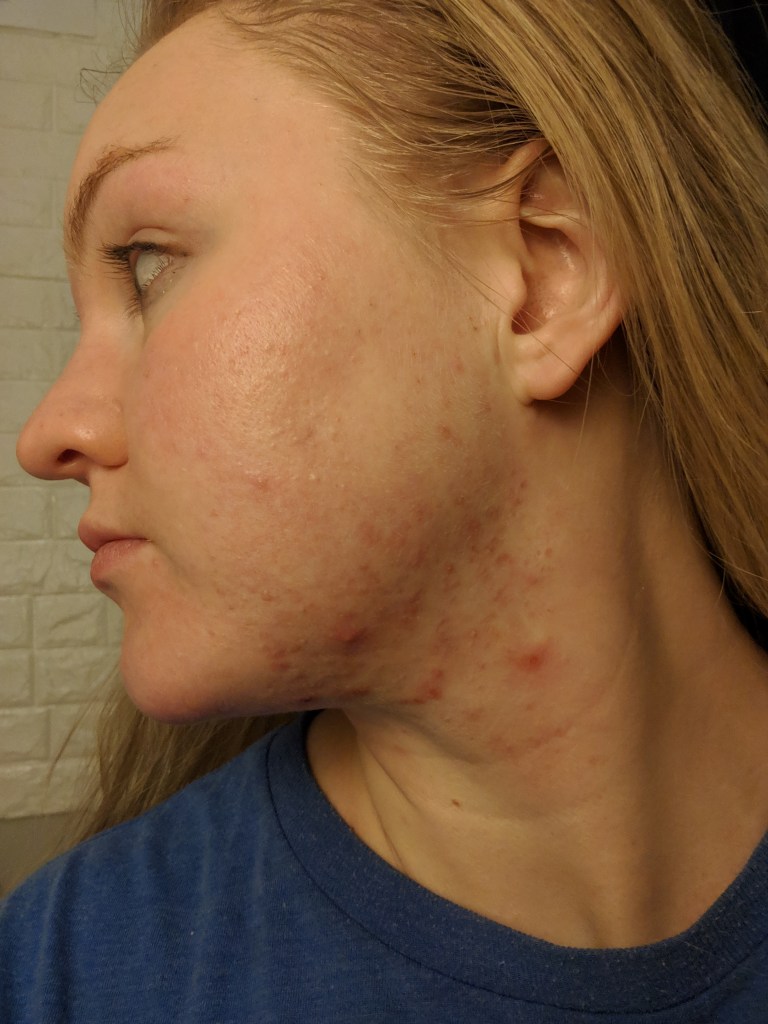
You can see in the image above that the acne was all over my face, but it was really bad around my jaw-line and my neck. From face mapping, we know that acne around the jaw and neck is typically caused by hormonal imbalances. Some women also experience hair growth along their jaw line. I thankfully did not get that, but I often thought about Shania Twain’s lyric “I wish that I could grow a beard, to cover up my spots”.
This was so difficult for me. I was brought right back to high school where I was trying all kinds of facial creams, face washes, treatments, constantly poking at my face and waking up worried that another huge pimple had appeared. I developed the very nasty habit of waking up and immediately feeling around my neck and jaw for new spots.
This is what kicked my research into women’s hormones into high-gear. I needed to figure out what was happening and if there was anything I could do besides getting back on the pill to get my skin glowing again.
Discovering Post-Birth Control Syndrome
I can remember exactly where I was when I listened to the life-changing podcast that finally explained what was happening to my body. I was back in the neighbourhood I grew up in, walking my dog and listening to a podcast. I had been listening to a podcast called “Health Hormones for Women” podcast (now called Wellness Witch) for some time but on episode 46, they had Dr. Jolene Brighten on to talk about “What We’re Not Told About Coming Off the Pill”.
The podcast explained everything to me. How the pill depletes certain vitamins and minerals, why I felt like I had no libido, how it impacted my mental health, and why I was experiencing the myriad of symtoms I was experiencing. And, thankfully, she also spoke about some initial lifestyle changes that we can make to help improve the experience.
The major one was limiting sugar intake and limiting the intake of foods that can lead to inflammation in women. So, true to my personality, I took this to the extreme and tried the ketogenic diet for the first time.
My mom and sister had already been on the diet, but I was always hesitant to try because I didn’t feel it was responsible to be on diets when I was actively working as a personal trainer promoting a balanced “diet” of “everything in moderation”.
So I began my keto journey and although it was difficult at first as the usual symptoms of keto flu and sugar withdrawals came and went, I did notice a difference in my skin.
I used to get really itchy after eating just about anything, but mainly foods high in salt and sugar. So when I was on the keto diet and not eating sugar, and only having salt as a seasoning, all of a sudden I wasn’t getting itchy skin anymore.
I also experienced the mental health benefits of the keto diet, which really helped manage the experience of post-birth control syndrome. I used to live in a constant state of stress and panic and exhaustion from being stressed and panicked all the time. I wasn’t able to focus at work and the quality of my work suffered. On the keto diet, I became laser focused, had a ton of energy and was feeling more balanced in my mood. My skin clearing up through all of this also helped balance my mood.
Before I go any further – I just want to say that this is not meant to be an endorsement of the keto diet. At the time it was a tool I used to help me manage the symptoms of the PBCS. It is an extreme diet and I don’t want anyone to think that I am promoting it for everyday use.
After 6 months, I got a period again. Then again 3 months after that, and eventually I was getting regular, monthly periods. My skin cleared up and I was feeling much better. There were other tips from the book “Beyond the Pill” that I never got to try, like prenatal supplements, but I felt like I had control over my experience and I was feeling much more informed about women’s hormones, the importance of our cycle, how our hormones impact our nutrient absorption, and how to manage coming off of the pill.
Getting back on the pill
Plot twist – I did get back on the pill, but I want to walk you through why I decided to do this after going through a difficult year with PBCS symptoms.
In March 2019, after over a year of being off of the pill, I accepted an offer to go to Sweden to be an au pair. At this point, I was getting regular facials, has eased off of the keto diet, and was feeling better about my skin, but not completely satisfied. I knew I wanted to go to Sweden and feel confident, so after much contemplation, I made an appointment with my gynaecologist with the intention of getting an IUD so I would never have to worry about finding a way to get my birth control pills in Sweden.
When I got to the appointment, the doctor was amazing. I explained my situation and she said she would be happy to make an appointment for the IUD, but she gave me a very important warning first. Although the IUD is effective for birth control, it will likely make my skin worse because IUDs are primarily progesterone, which doesn’t have the skin-clearing effects of estrogen.
I was not about to go through another skin journey, so I asked for my options and she explained that she can write me a prescription for birth control and we can ask for all 12 months to be prepared for pick-up, with the understanding that 9 of them won’t be covered by insurance. She also mentioned that going on and off the pill really increases the risk of ovarian cancer and blood clots, so I wasn’t to come off of the pill this time unless I was absolutely certain that it would be for good.
So I got back on the pill and my skin cleared up to point that I felt confident enough to have no make-up days, I stopped wasting money on crazy skincare treatments and I generally felt better.
As of this writing, I am still on the birth control pill. I have however had great conversations with my girlfriends and sisters about getting off the pill. I was able to take my experience with PBCS and help them navigate their own journey coming off of the pill.
Where Am I Today with my Birth Control
From their experience, the advice that was most helpful was taking prenatal supplements, as this will fast-track your body’s replenishing of nutrients that the pill made you deficient in. Eating a low inflammatory diet for at least 3 months after coming off of the pill also proved to be helpful. Avoiding things like processed sugar and salty foods, limiting caffeine and alcohol intake, and getting a variety of fruits, vegetables and protein was key to making sure the internal systems were operating at peak performance to help support the hormonal changes that were taking place.
Personally, I live with a constant hesitancy to get off of the pill. Even though I know how to navigate the challenges of PBCS, the experience was so difficult for me that I worry those tools won’t be enough.
I am a single woman, with a human-facing job and an active social life. The thought of going out into the world and feeling low confidence because of my skin is something I really struggle with. So as it stands, I am staying on the pill, but slowly making lifestyle changes that will make coming off of the pill easier.
These changes are:
- reducing my alcohol intake
- keeping my bedding clean so my skin is in good health
- finding a skincare routine that works for my skin type and my budget
- reducing my processed sugar intake
- reducing my intake of foods that lead to inflammation in my body (every body is different)
- limiting my coffee and dairy intake
- testing prenatal vitamins to figure out which ones I would reliably take every day during the transition period off of the pill
I hope that by making each of these changes gradually, that when I come off of the pill, I will be in the best place possible with my health to make for a smooth transition off of the pill. When that time comes, I’ll be joining Natural Cycles after seeing the success that my sister and friends have had with the app. It’s helped them get off the pill, enjoy intimacy with their partners without the risk of an unplanned pregnancy, and for the women planning pregnancies, helped them plan accordingly.
Post-birth control syndrome is very real and can be very challenging. It is my hope that by sharing my story, you feel like you are seen and heard and understood in your own post-birth control experience. None of this should be taken as medical advice, and is only meant to act as anecdotal evidence of the PBCS experience. If you are concerned about coming off of the pill and having adverse symptoms, then I recommend you speak with your doctor and create a game plan that is unique to you.
Thank you for letting me share this experience with you. It isn’t always easy being a woman, but I truly hope that you can come away from this feeling like you have a path forward to confidently come off of the pill.
 Riley Pearce
3 thoughts on “My Experience with Post-Birth Control Syndrome (PBCS)”